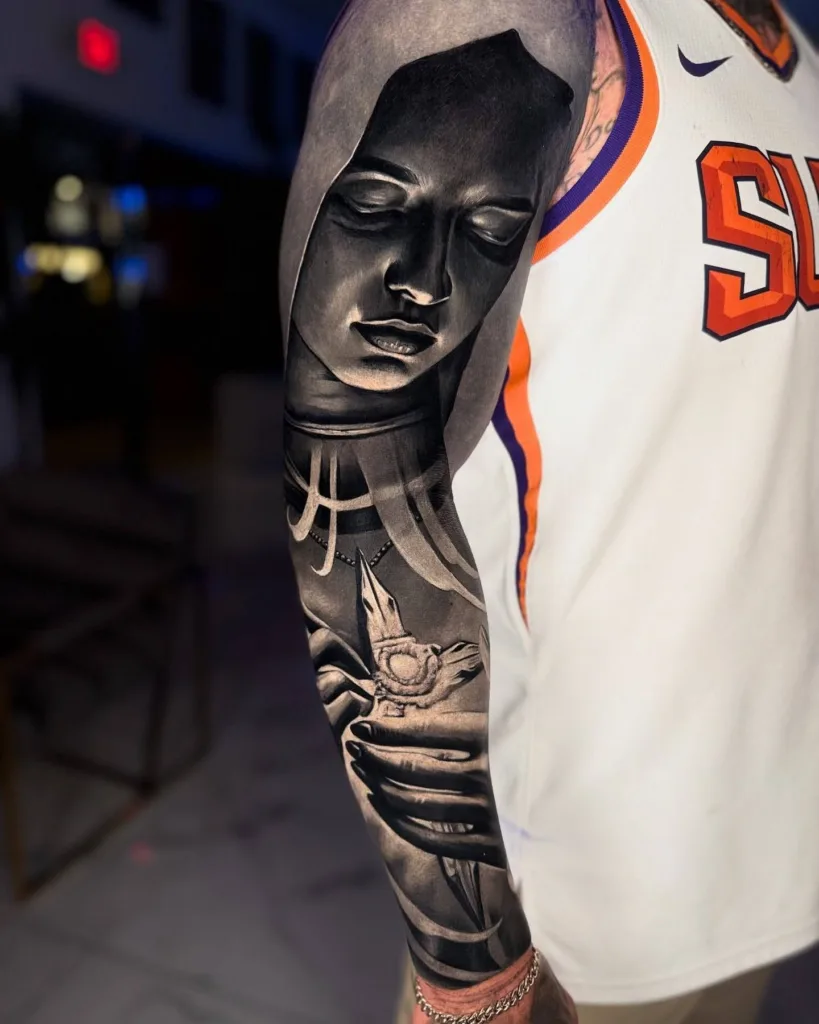


Black and Grey Tattoo Nashville: Why This Style Dominates and Where to Get It Done Right
Looking for a black and grey tattoo in Nashville? Learn what you need to look for—and what you need to avoid—when shopping for the right artist.
Key Takeaways
- Black and grey tattoo work in Nashville is in high demand—but it’s one of the most technically demanding styles to execute correctly
- The style relies entirely on tonal range and shading depth—mistakes can’t be hidden with color
- Black and grey realism ages more predictably than color work, making it one of the strongest long-term choices
- Subject matter that suits the style: portraits, cinematic characters, wildlife, dark surrealism, nature scenes
- Jake Ingersoll at Skin Design Tattoos Nashville specializes in both black and grey realism and color realism—with a portfolio built around subjects that demand technical precision
- Sizing is critical: black and grey work loses tonal depth and readability at undersized scales
- Healed portfolio review is the only honest measure of an artist’s black and grey ability—fresh photos don’t show how the shading holds
- Sun protection after healing is the most important long-term maintenance habit for preserving tonal contrast
Why Black and Grey Realism Is the Most Technically Demanding Style in Tattooing
Color work can hide a lot of technical problems. Strategic saturation, bright fills, and vibrant pigment draw the eye and mask inconsistencies in shading or form.
Black and grey realism has nowhere to hide.
When you strip color out of the equation, what remains is pure technique: the artist’s ability to build dimensional depth through layered tonal gradients, to create the illusion of texture using only black ink and negative space, and to maintain consistent transitions from highlight to shadow across an entire piece. Every soft edge either works or it doesn’t. Every tonal shift either reads as intentional form or falls flat.
That’s what makes black and grey tattooing the benchmark for technical skill—and why finding the right artist in Nashville matters more than it does for more forgiving styles.
What Makes Black and Grey Realism Work
Black and grey realism isn’t just tattooing without color. It’s a specific technical approach built around a few core principles that separate strong work from weak.
Tonal Range
The distance between the lightest value and the darkest value in a piece determines its depth. Work with a narrow tonal range feels flat—everything reads at the same middle-grey, and the piece loses the dimensional quality that makes realism compelling.
Tattoo designs by Storm, Jake’s tattoo apprentice, at our Nashville tattoo shop
Strong black and grey tattooing uses the full range: deep blacks in the shadow areas, smooth midtones that build through layered shading, and preserved highlights where the skin itself serves as the lightest value. That full range is what makes a portrait look three-dimensional and a wildlife piece look alive.
Smooth Gradient Transitions
The transitions between tonal values—from shadow to midtone to highlight—have to be smooth. Harsh transitions create visible banding that reads as poor execution. Smooth, even gradients require consistent needle technique and an understanding of how different needle configurations build ink differently in the skin.
This is learned over years. It’s not something an artist who primarily works in bold traditional or fine line can approximate in a single style pivot.
Texture Rendering
Black and grey realism can convincingly simulate skin texture, fur, feathers, stone, fabric, and dozens of other surfaces—all using the same tool, the same black ink, and variations in technique. The difference between a portrait that looks like a photograph and one that looks like a grey smear is entirely in how the artist renders texture.
A face with real skin texture has directional shading that follows the planes of the face. Fur has consistent direction and value variation that mimics the actual light-catching behavior of individual hairs. These are technical decisions the artist makes before a needle touches skin.
Black and Grey vs. Color: Which One Is Right for You?
Both styles work for the same subjects—but they produce fundamentally different results, and the choice isn’t just aesthetic.
Black and grey realism ages more predictably. Black ink breaks down more slowly than color pigment under UV exposure. The tonal structure of a black and grey piece tends to hold its integrity longer, meaning the contrast and depth that make the piece work at year one are largely still present at year ten with appropriate care.
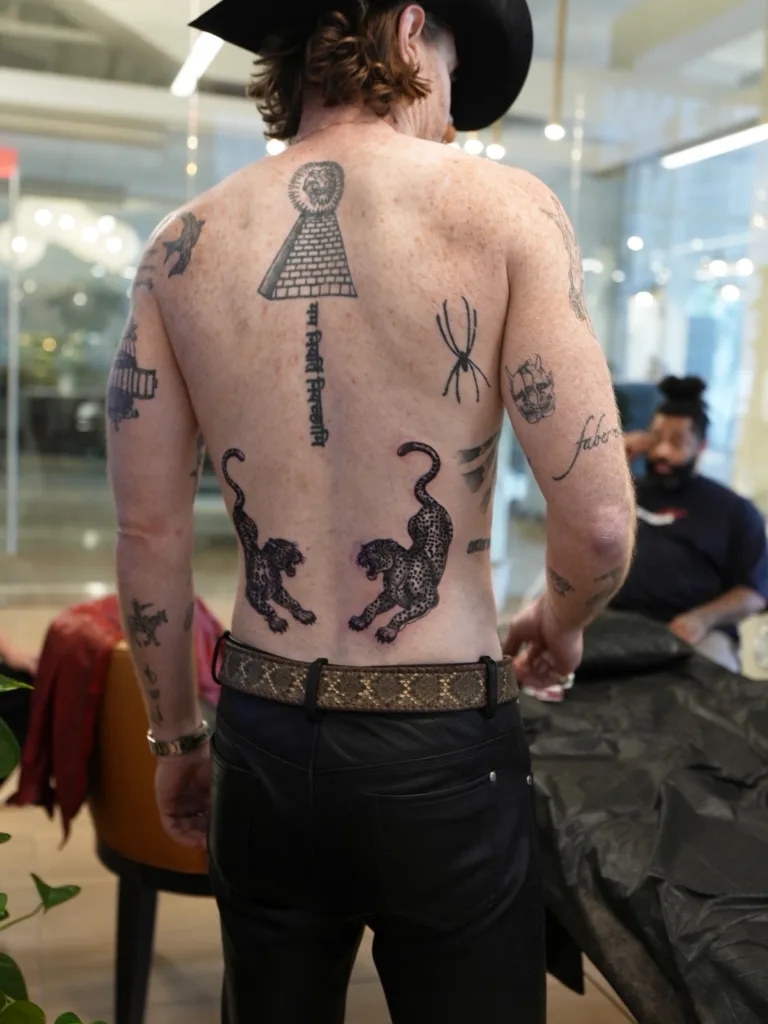
Leopard back tattoos by Skin Design Tattoos Nashville artist Jake Ingersoll — text ‘JAKE’ to (702) 297-6079 with your ideas for a free consult
Color realism captures subjects that are defined by their palette—animated characters, vibrant natural subjects, anything where color is inseparable from the identity of the image. A black and grey version of a brightly colored subject loses a defining characteristic. Color is the right choice when the subject demands it.
For subjects that aren’t color-dependent—portraits, cinematic scenes, wildlife, dark art, geometric shading—black and grey is typically the stronger long-term investment. It reads as mature and serious, ages well, and in skilled hands produces work that genuinely looks like it belongs in a gallery.
If you’re deciding between the two and don’t have a strong preference, it’s worth discussing with your artist. The subject matter often makes the right answer clear.
Jake Ingersoll: Black and Grey Realism in Nashville
Jake Ingersoll’s work at Skin Design Tattoos Nashville sits at the intersection of technical realism and subjects that demand that technique.
His specialization covers both color realism and black and grey realism—and the black and grey side of his portfolio reflects genuine mastery of the tonal precision this style requires. His subject matter—movies, anime, comics, video games—creates a particular challenge in black and grey: these subjects come with built-in reference points in the viewer’s mind.
When you render Darth Vader or The Joker or a specific anime character in black and grey, the likeness has to land. The tonal choices have to capture not just the shapes but the atmosphere and feeling of the source material.
That combination of technical skill and genuine investment in the subject matter he works with is what separates his black and grey work from artists who can approximate the style without connecting with the content.
Subject Matter That Works Best in Black and Grey
Not every subject is equally suited to black and grey. These categories translate particularly well.
Portraits
Portrait work is the natural home of black and grey realism. The style was essentially built for it—skin texture, dimensional shading, and tonal rendering of facial features are exactly what the style does best.
Memorial portraits, family portraits, celebrity portraits, cinematic character portraits—all of them benefit from the depth and gravitas that black and grey realism produces. Color portraits are valid, but there’s a reason the most technically ambitious portrait artists tend to work primarily in black and grey: the style rewards the precision that likeness demands.
A portrait done wrong in black and grey is a flat, ambiguous face. A portrait done right is something that stops people and makes them look twice.
Black and grey realism portrait with a touch of color by Skin Design Tattoos Nashville artist Jake—text ‘JAKE’ to (702) 297-6079 to book
Cinematic and Pop Culture Characters
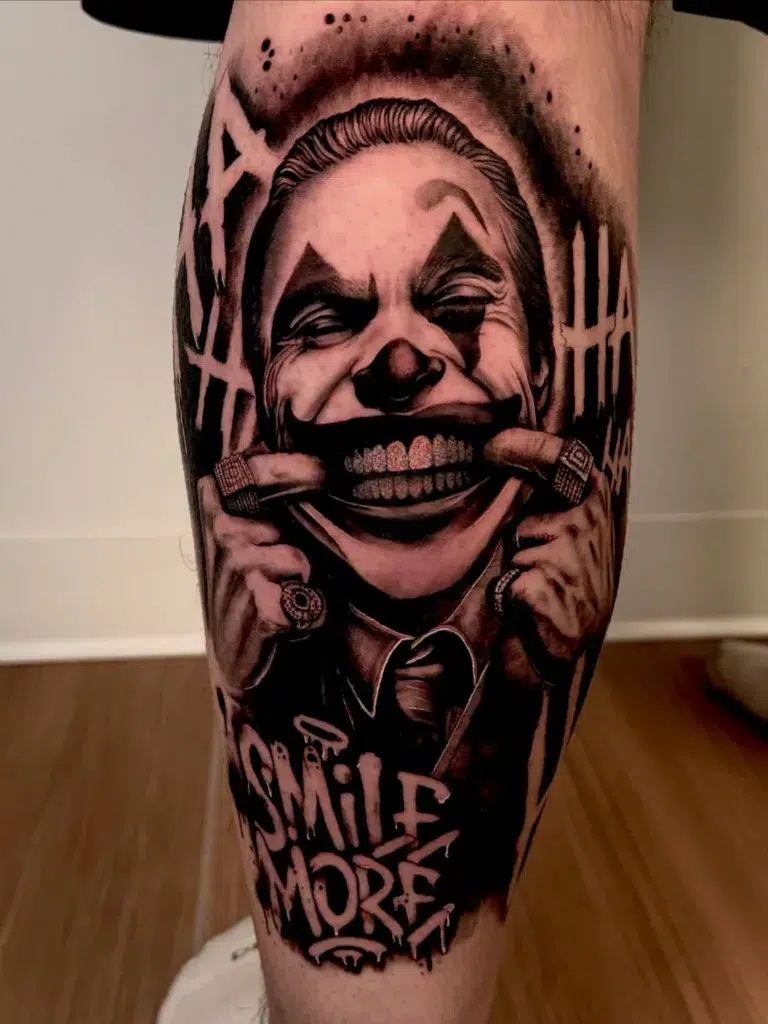
Dark cinematic characters and subjects with strong atmospheric identity translate powerfully into black and grey. The Joker, Darth Vader, horror icons, noir-influenced film subjects, characters defined by shadow and mood—these subjects don’t lose anything in translation to black and grey.
In many cases, they gain something: the monochrome treatment amplifies the atmosphere that makes them compelling in the first place.
For anime and manga subjects, black and grey realism requires an artist who understands how to translate stylized proportions—the distinctive eyes, the expressive linework—into tonal rendering without losing the character’s identity. It’s technically demanding work that benefits from both style expertise and genuine familiarity with the source material.
Black and grey realism Joker portrait by Storm, Jake’s tattoo apprentice—text ‘STORM’ to (702) 297-6079 or book via inkquiries.com/storm to talk ideas
Wildlife and Nature
Eagles, wolves, bears, big cats, birds in flight—wildlife subjects are among the most visually powerful choices for black and grey realism. The style captures the texture of fur, feathers, and scales in a way that color work sometimes obscures. A black and grey wolf rendered with proper tonal depth and directional fur texture reads as genuinely alive.
Nature compositions—detailed botanical work, mountainscapes, atmospheric woodland scenes—also work beautifully in black and grey, particularly when the design leverages negative space to create contrast and visual breathing room.
Dark Surrealism and Abstract
Artists and clients drawn to darker, more conceptual work—gothic imagery, horror-influenced pieces, surreal compositions—often find that black and grey realism is the natural medium for it. The style’s inherent gravity and its ability to render atmospheric shadow make it a natural fit for subjects that are more about mood than literal representation.
What to Bring to a Black and Grey Consultation in Nashville
Reference quality matters in any tattoo consultation, but it’s particularly consequential for black and grey realism—because the artist needs to understand the tonal range and texture of the subject to plan the shading approach.
Strong reference material includes:
- High-resolution images of the subject—photographs, official character art, or high-quality screencaps rather than low-resolution fan art or screenshots
- Multiple lighting conditions if possible—seeing how your subject looks in different light gives the artist information about where the natural highlights and shadows live
- Examples of black and grey tattoos in a style you find compelling—these communicate aesthetic direction (dramatic contrast vs. subtle, delicate tonal range, approach to negative space)
- Any specific mood or atmosphere you want the piece to capture—sometimes a reference isn’t the exact subject but an image that communicates the feeling you’re after
An artist who studies your references carefully, asks about the emotional weight behind the piece, and offers honest guidance on what’s achievable at a given size is one who will produce the strongest result.
Sizing: Why It Matters More in Black and Grey Than You Might Think
Black and grey realism depends on tonal range and smooth gradients to work. Both require physical space to build.
When a black and grey piece is too small for its level of detail, the gradients that create dimensional depth get compressed. Shadow areas that should transition smoothly from dark to midtone get pushed together. Highlights that should be distinct from midtones merge into the same value. The result is a piece that looks flat and dense rather than dimensional and atmospheric.
Black and grey realism portrait with a touch of red ink by our resident Nashville tattoo artist Dan Bostic—click here for a consultation
Your artist will give you specific guidance at the consultation. If they recommend larger than you initially planned, the reason is almost always that the subject requires that surface area to hold its tonal structure. This is particularly true for:
- Portrait work, where facial planes need room for proper tonal transitions
- Wildlife subjects with detailed texture, where fur or feathers require space to render directionally
- Cinematic compositions with strong contrast, where the distance between light and shadow defines the mood
- Multi-figure or scene-based compositions, where multiple subjects need visual separation
Fine line tattoo in black and grey ink done at Skin Design Tattoos’ Nashville shop—notice the minimal detail but solid execution
Placement Considerations for Black and Grey Work
Strong placements for black and grey realism:
- Outer upper arm and shoulder — reliable surface, good for character or wildlife portraits, enough area for tonal depth
- Thigh — large canvas, excellent for scene work or full animal compositions, heals well
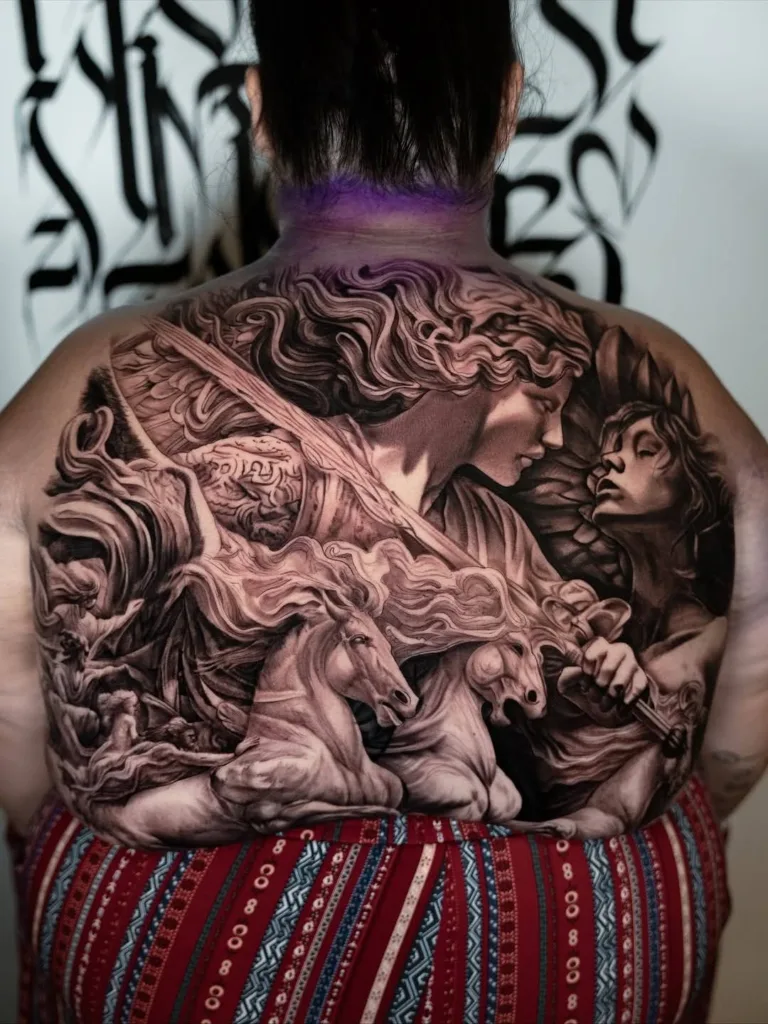
- Back and chest — the largest available canvases; suited to ambitious multi-element or full-scene compositions
- Calf — strong visibility, good for self-contained portrait or animal pieces
Placements to approach with caution:
- Hands and fingers — ink migrates faster, and the fine tonal gradients of black and grey work are the first to blur
- Inner wrist and forearm interior — smaller usable surface area; fine gradients in exposed areas require more maintenance
- Feet — high fade rate due to friction and constant skin cell turnover
The forearm is a popular and valid placement, but it’s worth discussing sun exposure honestly at the consultation—Nashville’s spring and summer UV is significant, and forearms are frequently exposed. Consistent sun protection is what keeps the tonal contrast intact over years.
Long-Term Care for Black and Grey Tattoos
Black and grey work ages more reliably than color, but that reliability is contingent on appropriate care during healing and consistent habits afterward.
During healing: Wash gently twice daily with fragrance-free soap, moisturize lightly with unscented lotion, stay out of direct sun, avoid submerging in pools or ocean, and don’t pick or scratch peeling skin. The peeling phase is when most damage happens—flaking skin during healing is attached to ink underneath, and pulling it prematurely creates light spots and tonal inconsistencies.
Long-term: Sun protection is the most impactful maintenance habit. Black ink breaks down more slowly than color pigment under UV exposure, but it does break down. Consistent SPF 30 or higher before any significant sun exposure is what keeps the tonal depth that makes black and grey work compelling. Nashville summers mean significant UV from April through September. This is a small habit with a measurable long-term payoff.
When to assess the healed result: At six to eight weeks for most pieces. Not before. Black and grey work goes through a cloudy, muted phase during weeks two through four as new skin forms over the healing ink. What looks like lost contrast at week three is usually fully restored by week eight.
FAQ
What is black and grey tattoo realism?
Black and grey realism is a tattooing style that uses gradients of black ink—no color—to create photographic depth, dimensional shading, and realistic texture. It produces portraits, wildlife, cinematic subjects, and nature compositions that look three-dimensional rather than flat. The style is one of the most technically demanding in tattooing because every tonal decision is visible, with no color to distract from or compensate for weak execution.
Does a black and grey tattoo in Nashville cost more than color work?
Both black and grey realism and color realism are typically priced at the higher end of the hourly range due to the technical complexity and time involved. The key factor is artist experience—a specialist in black and grey realism charges for the years of skill development that the style demands. Quality studios in Nashville typically run $150 to $250+ per hour for specialist work. Financing through Affirm and Klarna is available at Skin Design Tattoos with payment plans up to 24 months.
How long does a black and grey tattoo take?
A single character or wildlife portrait of medium size typically requires four to eight hours. Large-scale scene work or full compositions with multiple figures can span multiple sessions. Your artist will give you a specific estimate at the consultation based on the design, complexity, and sizing.
Does black and grey realism age better than color?
Generally, yes. Black ink breaks down more slowly under UV exposure than color pigments, particularly the lighter colors—yellows, pinks, and pastels—that tend to fade fastest. A well-executed black and grey piece with consistent sun protection after healing typically maintains its tonal structure and contrast significantly longer than a comparable color piece. That said, no tattoo is immune to aging—proper placement, sizing, and aftercare habits all affect the long-term outcome.
What subjects work best for black and grey tattoos?
Portrait work, cinematic and pop culture characters, wildlife and nature subjects, and dark surrealism or conceptual art all translate powerfully to black and grey. Subjects that are defined by their color—animated characters with specific palettes, for instance—may be better suited to color realism, since black and grey removes a defining visual characteristic. Your artist can advise on which approach suits your specific subject best.
How do I find the right black and grey tattoo artist in Nashville?
Look for an artist whose portfolio is built specifically around black and grey realism—not an artist who lists it as one of many styles they offer. Request healed examples, not just fresh photos. Healed work is the honest measure of tonal consistency and gradient quality. Book a consultation before committing to a session, and pay attention to how the artist discusses your specific subject.
Can anime or pop culture characters be done in black and grey?
Yes—and for the right subjects, it’s a powerful choice. Dark cinematic characters, subjects with strong tonal contrast, and atmospheric or mood-driven pieces often translate exceptionally well into black and grey. Subjects defined by specific bright color palettes may be better suited to color realism. Jake Ingersoll at Skin Design Tattoos Nashville specializes in exactly this category—pop culture subjects rendered in both color and black and grey realism—and can advise on which approach suits your specific character or scene.
What should I avoid during healing a black and grey tattoo?
The same rules apply to black and grey as to all tattoos, but tonal work is particularly vulnerable to two things: picking and sun exposure. Picking peeling skin during weeks one and two removes ink and creates light patches in what should be smooth tonal gradients—these are visible and difficult to correct. Sun exposure during healing degrades pigment before it has fully settled into the skin. Gentle washing, light moisturizing, and keeping the piece covered or protected during the healing window are the three most important habits.
Ready to Talk About Your Black and Grey Piece?
Black and grey realism done right is some of the most technically impressive work in tattooing. Done wrong, it’s a flat, muddy approximation of what it could have been.
At Skin Design Tattoos Nashville, Jake Ingersoll’s specialization in black and grey realism—applied to portraits, cinematic subjects, anime, wildlife, and dark conceptual work—means your piece gets built on years of dedicated technical development. Not an artist who dabbles in the style. One who has built a portfolio around it.
Bring your references. Come with questions. Leave with a plan.
Text 702-297-6079 to book your free consultation.
Or start online at skindesigntattoos.com/tattoo-consultation/
Financing available through Affirm and Klarna—payment plans up to 24 months at skindesigntattoos.com/financing/
Looking to Get Tattooed Outside of The Music City?
Skin Design Tattoos also has tattoo shops in:
Let’s create something you’re proud to wear for life.