
Black and Grey Realism Tattoo: What It Is, Why It Endures, and How to Get It Right
Key Takeaways
- Black and grey realism is the most technically demanding tattoo style—tonal range, dimensional shading, and subject likeness are all measured against a high standard
- The style ages better than almost any other when executed correctly: no color to fade, bold contrast that holds over decades
- Best subjects are those with strong visual identity and tonal complexity—portraits, wildlife, horror iconography, dark surrealism, atmospheric scenes
- Size matters more in black and grey realism than in almost any other style—compressed gradients produce muddy results
- Healed portfolio review is non-negotiable when choosing a black and grey realism artist; fresh photography hides what the style actually demands
- Robert Pho built Skin Design Tattoos on more than three decades of black and grey realism—it’s the foundation the studio was built on
- SDT artists across Las Vegas, Honolulu, Nashville, SoHo NYC, and Orange County specialize in the style at the level serious collectors expect
- Consultations are free—text 702-297-6079 or book at skindesigntattoos.com/tattoo-consultation/
What Black and Grey Realism Actually Is
Black and grey realism is the most technically demanding style in tattooing. It aims to render subjects—portraits, animals, characters, scenes—with the dimensional accuracy of a photograph, using only black ink diluted to varying concentrations to create the full tonal range from deep shadow to bright highlight.
There’s no color to carry the image. No bold outline to anchor the composition. The entire piece depends on tonal gradients—the controlled transition from dark to light that creates the illusion of three-dimensional form on a two-dimensional surface. When those gradients are executed well, the result is a piece that looks like it has depth, weight, and atmosphere. When they’re not, the work looks flat, muddy, or washed out.
That technical ceiling is also what makes the style enduring. Black and grey realism done correctly doesn’t depend on color trends or stylistic fashions. It depends on craft—and craft doesn’t expire.
The History Behind the Style
Black and grey tattooing has roots in the prison culture of Southern California in the 1970s and 1980s, where artists worked with limited materials—single needles, diluted ink, contraband implements—and developed a distinctive aesthetic out of necessity. That aesthetic eventually migrated into professional studios, where artists like Jack Rudy and Charlie Cartwright refined it into the high-realism form the style is known for today.
Robert Pho, Skin Design Tattoos’ founder, spent more than three decades developing his practice within this tradition. His work—portraits, memorial pieces, full sleeves and bodysuits—represents the direction the style traveled from those origins to its current peak of technical sophistication. The studio he built, and the mentorship model he developed for the artists who work within it, reflects that lineage directly.
Understanding where the style came from matters when choosing an artist. Black and grey realism has a lineage. Artists who can trace their practice to that lineage—through training, mentorship, and years of focused development—produce fundamentally different work than those who have adopted the aesthetic without that depth.
What Makes Black and Grey Realism Technically Demanding
Tonal Range
The style’s entire visual vocabulary is built on the range from pure black to the lightest possible grey—and every gradation in between. An artist working in black and grey realism needs to understand exactly how diluted ink behaves in skin, how different needle configurations distribute pigment, and how gradients need to be constructed to account for how the skin will heal and change over time.
A tonal range that looks smooth in a fresh tattoo can separate into distinct bands as the skin heals if the transitions weren’t properly executed. What reads as atmospheric depth fresh can flatten into a grey smear at six months. The technique and the judgment behind it are inseparable.
Subject Likeness
When those elements are captured accurately, the piece is immediately recognizable and permanently compelling. When they’re off—by even small margins—the result is a piece that almost looks right, which is worse than something that makes no pretense of likeness.
This is why reference quality matters so much in black and grey realism. The artist is translating a source image into permanent skin, and the accuracy of that translation begins with the accuracy of the source.
Healed black and grey tattoo design by Skin Design Tattoos Las Vegas artist Lynn Hoang—text ‘LYNN’ to (702) 297-6079 to book
Atmospheric Shading
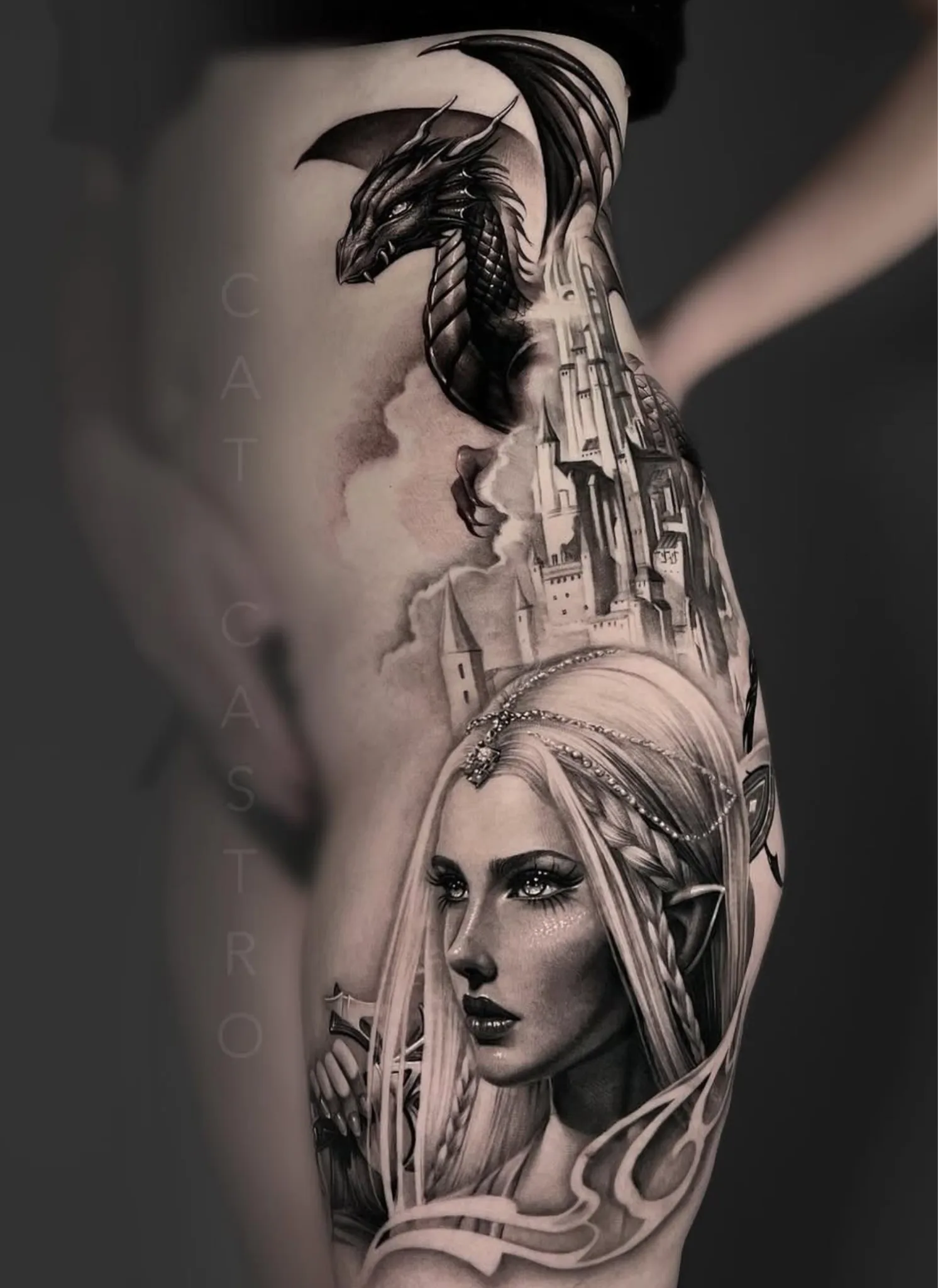
Scene-based and surrealist black and grey work—foggy environments, horror scenes, dreamlike compositions—depends on atmosphere rather than likeness. Here the technical demand shifts from accuracy to control: managing the density of shading to create the impression of depth, light, and mood without reference points that can be checked against a source image.
Black and grey realism chest piece by Las Vegas tattoo artist Nigel P—text ‘NIGEL’ to (702) 297-6079 to bring your vision to life
This is arguably the harder category. Portrait realism has a clear measure of success. Atmospheric work succeeds or fails based on whether the feeling lands—and that’s a judgment call that requires both technical skill and genuine artistic sensibility.
Award-winning black and grey realism tattoos by Skin Design Tattoos Las Vegas tattoo artist Reena Pho & Nigel P
The Best Subjects for Black and Grey Realism
The style excels with subjects that have strong tonal complexity and visual identity. Some categories consistently produce the strongest results.
Portraits and Memorial Pieces
The most emotionally significant category in black and grey realism. A portrait that captures a person’s likeness—the specific quality of their eyes, the particular way light fell on their face—is a piece that carries permanent meaning.
Memorial portraits of people who have passed are among the most requested and most technically demanding pieces in the genre.
Reference quality is the first variable. High-resolution photographs with strong natural lighting—ideally multiple angles—give the artist the full tonal information the piece needs. Dark, low-resolution, or heavily filtered photographs produce portraits that struggle at the fundamental step of capturing what the person actually looked like.
Wildlife and Animals
Birds, big cats, wolves, bears, octopuses, deer—subjects with strong tonal contrast and visually compelling texture. Feathers, fur, scales, and skin all translate into black and grey realism with remarkable fidelity when the technique is there.
Fresh tattoo (left) vs. healed tattoo (right) by renowned tattoo artist Robert Pho
Wildlife subjects also benefit from the style’s atmospheric capability: an eagle in flight against a storm sky, a wolf emerging from fog, a great white breaking the surface—the natural environment becomes compositional material.
Horror Iconography and Dark Surrealism
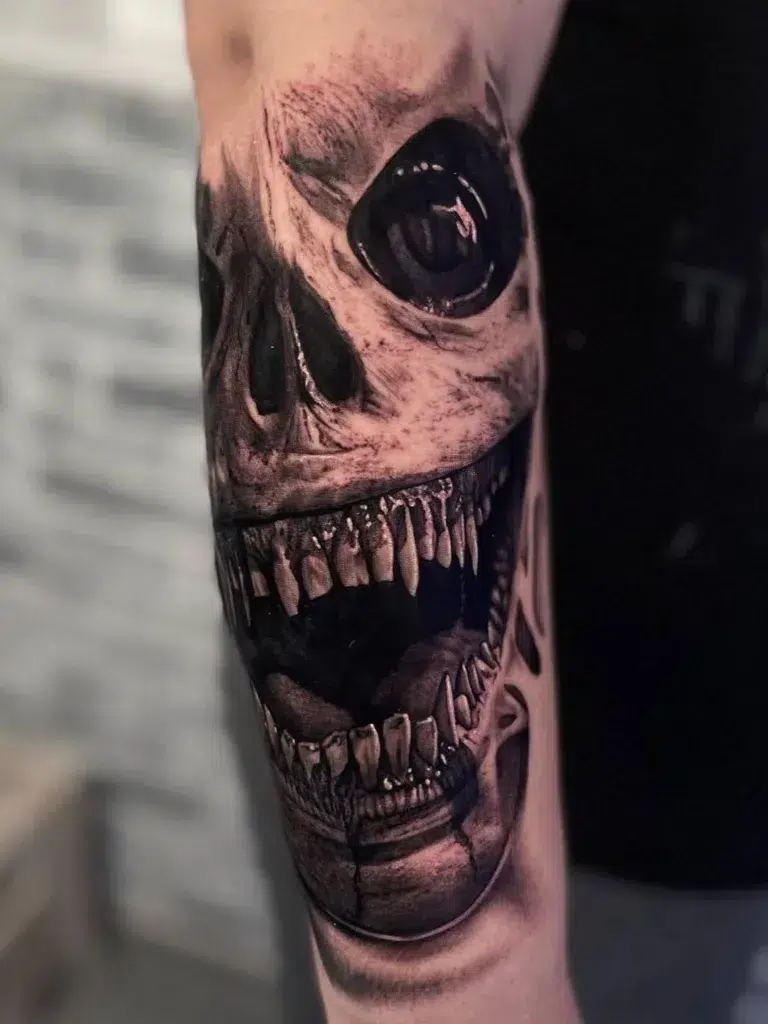
Classic horror characters, gothic imagery, dark surrealist compositions—some of the most visually arresting black and grey realism work being produced right now lives in this category.
Pennywise, Michael Myers, Freddy Krueger; skulls rendered with dimensional bone texture; ravens in mid-flight; figures emerging from shadow.
The darkness that defines horror imagery as an aesthetic is also what makes it technically suited to black and grey realism. The style’s tonal depth, its ability to render shadow and atmosphere, is precisely what horror iconography demands. The subjects are often immediately recognizable—which raises the technical bar on capturing their likeness accurately.
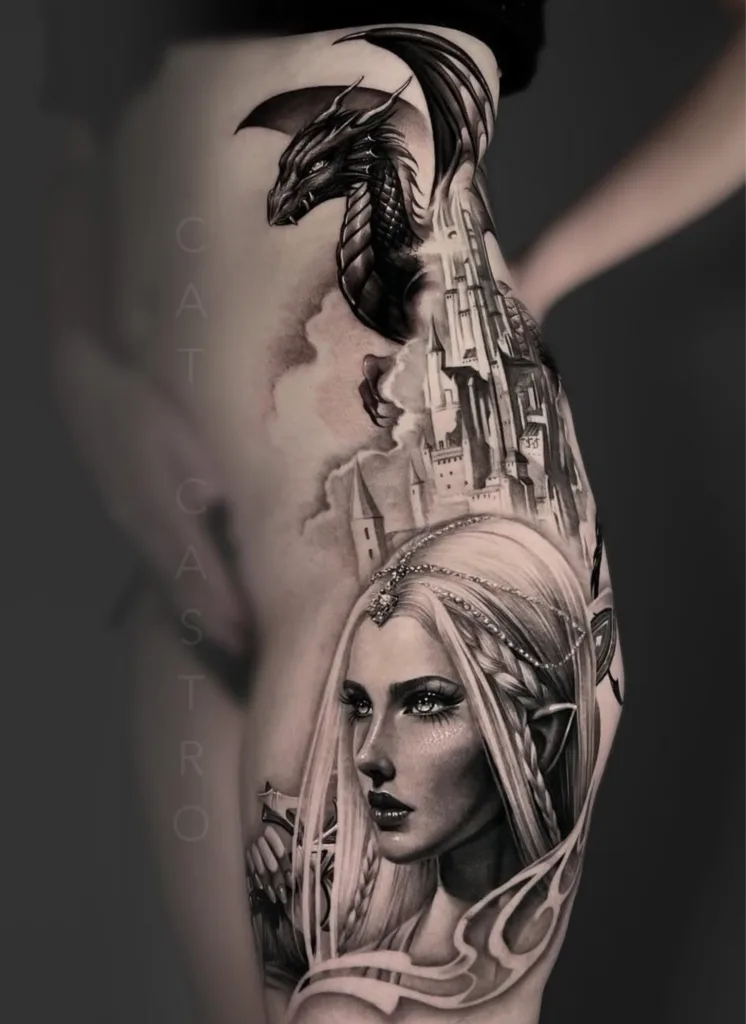
Black and grey tattoo realism horror sleeve tattoo by Skin Design’s very own Cat Castro (also featured on Ink Masters!)—click here to book your free consultation today
Religious and Spiritual Imagery
Portraits of religious figures, angels, sacred hearts, rosaries, praying hands—subjects with centuries of visual tradition behind them. Black and grey realism handles devotional imagery with a gravity that color work often can’t match. The lack of color gives these pieces a timeless quality that suits their subject matter.
Tattoo designs by Storm, Jake’s tattoo apprentice, at our Nashville tattoo shop
Cinematic Scenes and Literary Subjects
Scene-based compositions drawn from film and literature—the hallways of The Overlook Hotel, figures from Gothic novels, iconic cinematic moments rendered as atmospheric compositions rather than character portraits. These subjects reward close reading and produce pieces that carry literary and cultural depth alongside their visual impact.
Jake, our resident Nashville tattoo artist, at the 2025 Golden State Tattoo Expo
Size and Placement: Where Black and Grey Realism Fails Most Often
The most common reason a black and grey realism piece doesn’t live up to its concept is scale. The style requires space.
Tonal gradients need room to breathe. The transition from deep shadow to bright highlight—the core technical move in black and grey realism—requires enough surface area to construct properly. When a piece is too small for its level of detail, gradients compress.
Shadow areas merge into midtones. Highlights disappear into the surrounding skin. What was designed as atmospheric and dimensional reads as dense and unclear.
If your artist recommends going larger than you planned, the reason is almost always technical. That guidance is worth taking seriously.
Horror-themed black and grey realism portrait with red ink by award-winning Honolulu tattoo artist Christina Choi—send us a message to book yours today
Strong placements for black and grey realism:
- Outer upper arm and shoulder — Reliable, relatively stable surface. Enough area for proper tonal depth on medium to large portrait and character work.
- Thigh — One of the best canvases for detailed scene and portrait work. Large, heals well, limited sun exposure in everyday life.
- Back — The largest available canvas. The right surface for ambitious multi-figure compositions, large-scale portraits, and full back pieces.
- Chest — Strong placement for portrait and atmospheric work. Relatively stable; heals consistently when cared for properly.
- Calf — Good visibility, solid surface for self-contained portrait or atmospheric single-figure pieces.
Placements to approach carefully:
- Hands and fingers — Ink migrates faster on these high-contact surfaces; fine tonal gradients are among the first things to blur.
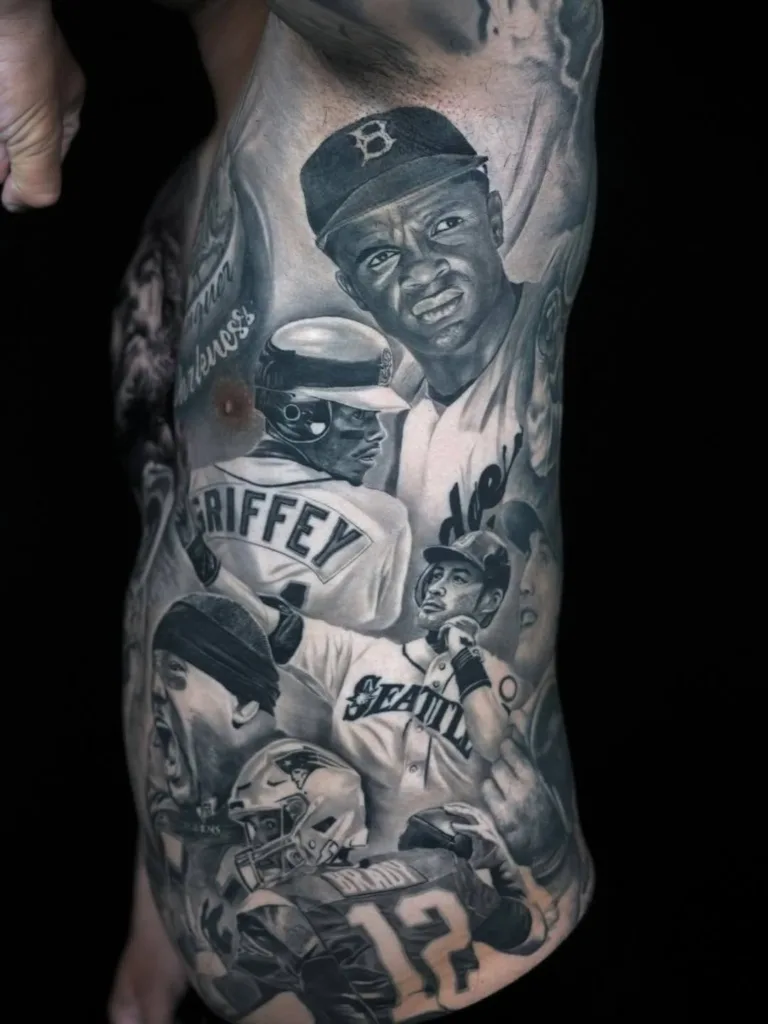
- Ribcage — Surface irregularity and movement can challenge gradient consistency. More technically demanding for the artist and more painful for the client.
- Inner arm — Softer skin that shifts with movement. Not impossible, but requires honest discussion about longevity.
Award-winning black and grey realism tattoos by traveling Skin Design Tattoos artists
How to Choose a Black and Grey Realism Artist
The decision begins and ends with healed portfolio work. Fresh tattoo photography is universally flattering; the style of photography matters as much as the quality of the work. What healed work reveals is what matters: whether gradients held, whether the tonal range maintained its contrast, whether portrait likeness survived the healing process.
Fully healed black and grey realism tattoo by award-winning OC, Las Vegas, and New York tattoo artist—and founder of Skin Design Tattoos—Robert Pho
Ask specifically to see healed examples. An artist confident in their black and grey realism will show healed work without hesitation. Resistance to showing it is information.
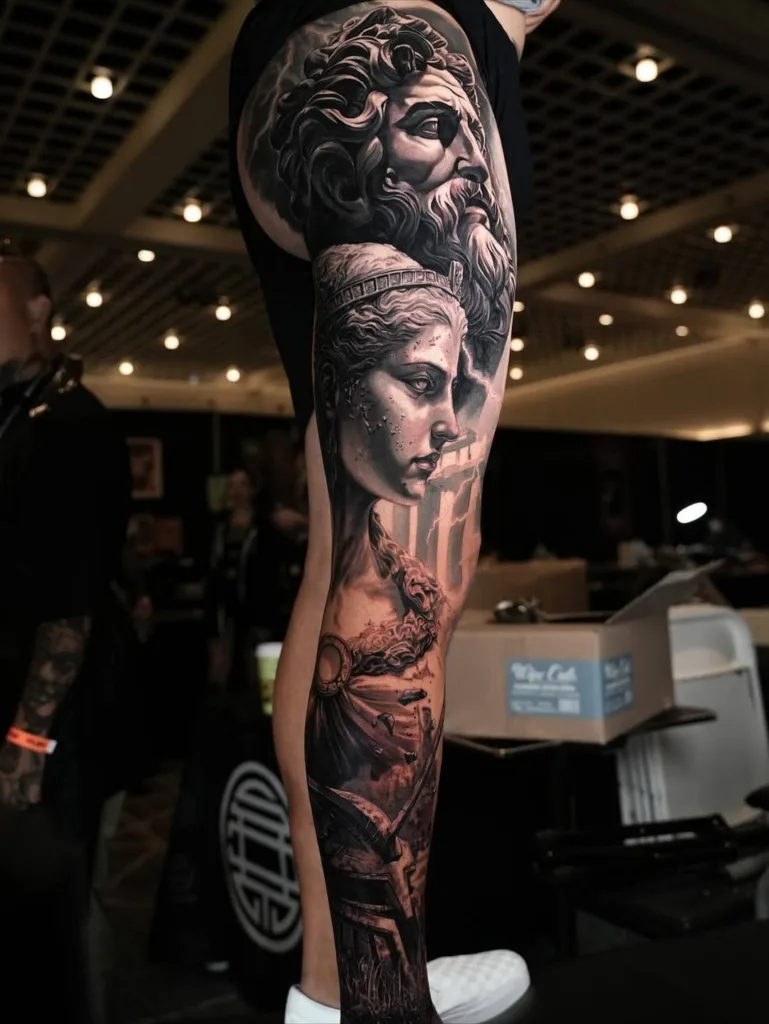
Healed and fresh black and grey leg sleeve by award-winning Honolulu tattoo artist Christina Choi—text ‘CHRISTINA’ to (702) 297-6079 for a free consult
Beyond healed work, look for genuine specialization. Black and grey realism artists who have spent years—or decades—developing the style produce fundamentally different work than those who offer it as one style among many. The specificity of the portfolio is the signal: an artist who has done a hundred black and grey portraits has developed judgment and muscle memory that an artist who has done ten simply doesn’t have yet.
Look also at the range of subjects in the portfolio. Portrait specialists are strong at portraiture; wildlife specialists at wildlife. An artist who can move across subjects—portraits, atmospheric scenes, wildlife, horror iconography—while maintaining consistent tonal quality has developed versatility that matters for complex custom projects.
Healed payasa portrait leg sleeve in black and grey ink by traveling SDT tattoo artist Sandra
Finally: how the studio approaches the consultation tells you how the artist approaches the work. Black and grey realism done correctly starts with a conversation—about your concept, your reference material, the placement and sizing that will serve the piece, and what healed results look like in the specific location you’re considering.
Black and Grey Realism at Skin Design Tattoos
Robert Pho built Skin Design Tattoos on black and grey realism. More than three decades of practice in the style—@robert_pho—produced not just a body of work but a mentorship model that has shaped the artists across every SDT location.
The roster across Las Vegas, Honolulu, Nashville, SoHo NYC, and Orange County reflects that lineage. Artists trained under Robert Pho, who have developed their black and grey realism practice within the standard he established, and who specialize at the level serious collectors expect.
Leopard back tattoos by Skin Design Tattoos Nashville artist Jake Ingersoll — text ‘JAKE’ to (702) 297-6079 with your ideas for a free consult
Whatever location is closest to you, the SDT approach to black and grey realism is the same: custom work, free consultations, and a standard of technical quality built over three decades.
Batman portrait tattoo done by Skin Design Tattoos founder and black and grey realism artist Robert Pho—text us at 702-297-6079 to make your vision a reality
FAQ
What is black and grey realism tattooing?
Black and grey realism is a tattoo style that renders subjects—portraits, wildlife, characters, scenes—with dimensional accuracy using only black ink diluted to varying concentrations. The entire visual effect depends on tonal gradients from deep shadow to bright highlight, without color or bold outlines. It’s the most technically demanding major tattoo style, and when executed correctly, produces work that looks three-dimensional and holds up over decades.
How long does a black and grey realism tattoo take?
It depends on scale and complexity. A medium-scale portrait—head and shoulders on an upper arm—typically runs four to eight hours. Large-scale sleeve work is planned across multiple sessions. Full back pieces can span years of ongoing sessions. Rushing black and grey realism compromises the tonal work. The piece takes as long as it needs to take.
Does black and grey realism tattoo age well?
Better than almost any other style when executed correctly. Without color to fade, the primary variable is the contrast between black and the skin’s natural tone. Black ink does lighten over time, but black and grey realism work from skilled artists maintains its tonal structure for decades with proper aftercare. Sun protection on healed work is the single most impactful long-term maintenance habit—UV exposure accelerates the lightening of black ink.
What's the difference between black and grey and black and grey realism?
Black and grey tattooing covers a wide range of work using only black ink—from traditional black and grey shading in illustrative styles to photorealistic rendering. Black and grey realism specifically refers to work aimed at photographic or near-photographic dimensional accuracy, where the subject’s tonal structure is precisely rendered rather than stylized or approximated. It’s a subset of black and grey tattooing at the highest technical end of the style.
What are the best subjects for black and grey realism?
Portraits and memorial pieces, wildlife with strong tonal contrast, horror iconography and dark surrealism, religious and spiritual subjects, and scene-based compositions from film and literature. The common thread is tonal complexity and strong visual identity—subjects that reward the dimensional depth the style creates.
How do I find a good black and grey realism artist?
Ask to see healed portfolio work in black and grey realism specifically. Look for genuine specialization—an artist whose portfolio is primarily built in the style—rather than a generalist who lists it among many others. Book a consultation before committing to a session. At Skin Design Tattoos, the entire studio standard was built around this style: consult at any location to see the work and discuss your project.
How much does a black and grey realism tattoo cost?
Quality black and grey realism at a specialist studio typically runs 150–250+ per hour. Large-scale work is planned and priced per session. Financing through Affirm and Klarna is available at Skin Design Tattoos with payment plans up to 24 months.
What should I bring to a black and grey realism consultation?
High-resolution reference images—official production photography for character subjects, professional photography for portraits, multiple angles where possible. Examples of healed black and grey realism you find compelling. And an honest account of your placement intentions and lifestyle, since placement and long-term care affect how the work ages.
Ready to Start?
Black and grey realism is the style Robert Pho built Skin Design Tattoos on—over thirty years, across every location, with every artist who has trained under the SDT standard.
The consultation is free. The process starts with your concept, your references, and a real conversation about what’s achievable.
We have award-winning tattoo shops in:
- Honolulu, Hawaii
- Brooklyn, New York
- Orange County, California
- Nashville, Tennessee
- SoHo, New York
- Las Vegas, Nevada
Text 702-297-6079 to book your free consultation.
Or start online at skindesigntattoos.com/tattoo-consultation/
Financing available through Affirm and Klarna—payment plans up to 24 months at skindesigntattoos.com/financing/