
How Long Does a Tattoo Take? Everything You Need to Know Before You Book
Wondering how long does a tattoo take? From small pieces to full sleeves, here’s what affects session length—and how to plan your appointment.
Key Takeaways
- How long a tattoo takes depends on size, complexity, placement, and the artist’s style
- A small, simple tattoo can be completed in 30 minutes to 2 hours
- A large custom piece or sleeve may require multiple sessions totaling 15–40+ hours
- Black and grey realism and fine line work often take longer than they appear—detail is time-consuming
- Your body’s tolerance for sessions matters as much as the artist’s speed
- Rushing a tattoo is one of the most common reasons quality suffers
- A consultation with your artist is the only reliable way to get an accurate time estimate
- Skin Design Tattoos builds session timelines around the work—not the clock
How Long Does a Tattoo Take? The Honest Answer
There’s no single answer.
And any artist who gives you a confident time estimate without looking at your design, your placement, and your body hasn’t thought it through.
How long a tattoo takes depends on a combination of factors—some controlled by the artist, some by the design, and some by your own physiology. Understanding each one helps you plan realistically, set the right expectations, and avoid the most common mistake clients make: trying to rush the process.
This guide breaks down every variable that affects tattoo session length, gives you realistic time ranges by tattoo type, and explains what to expect when you book a custom piece at a studio like Skin Design Tattoos.
The Factors That Determine How Long a Tattoo Takes
1. Size
Size is the most obvious variable—but it’s not the only one that matters, and it can be misleading on its own.
A large design with minimal detail can move faster than a small design packed with intricate linework or shading. Still, as a baseline, more surface area means more time under the needle.
A palm-sized tattoo and a full back piece are not the same conversation.
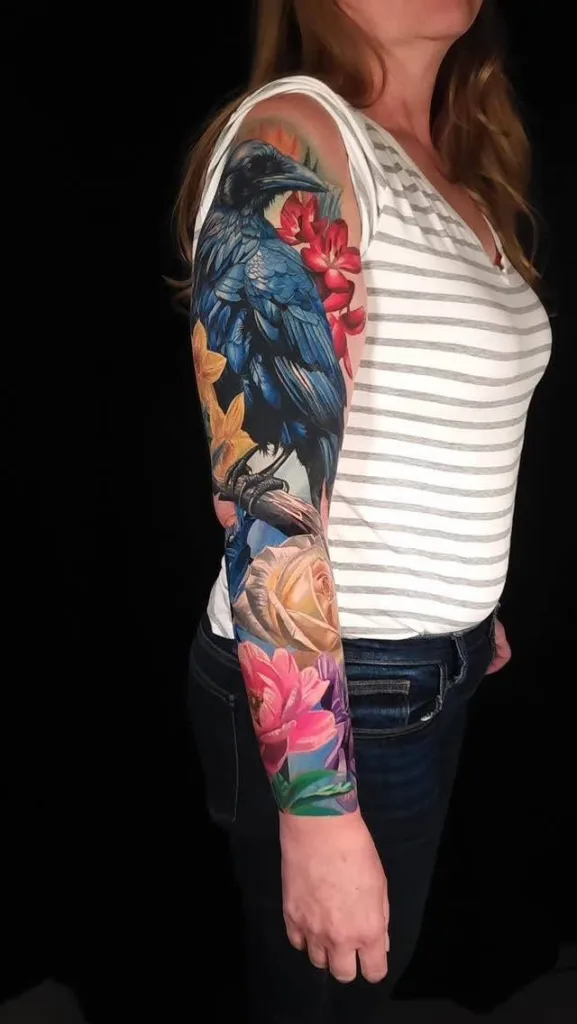
Best of show full color leg sleeve at the 2025 Hawaii Tattoo Expo by Skin Design Tattoos’ Honolulu’s award-winning artists, Christina Choi & Lynn Hoang. This piece took 5 sessions total.
2. Complexity and Detail
This is where most people underestimate session length.
A highly detailed portrait, a dense black and grey realism piece, or a composition with fine linework and smooth gradients requires the artist to work slowly and precisely. Rushing detail work shows—blown-out lines, uneven shading, and patches that don’t hold ink properly are all symptoms of moving too fast.
Simple bold linework moves faster. Fine detail takes as long as it takes.
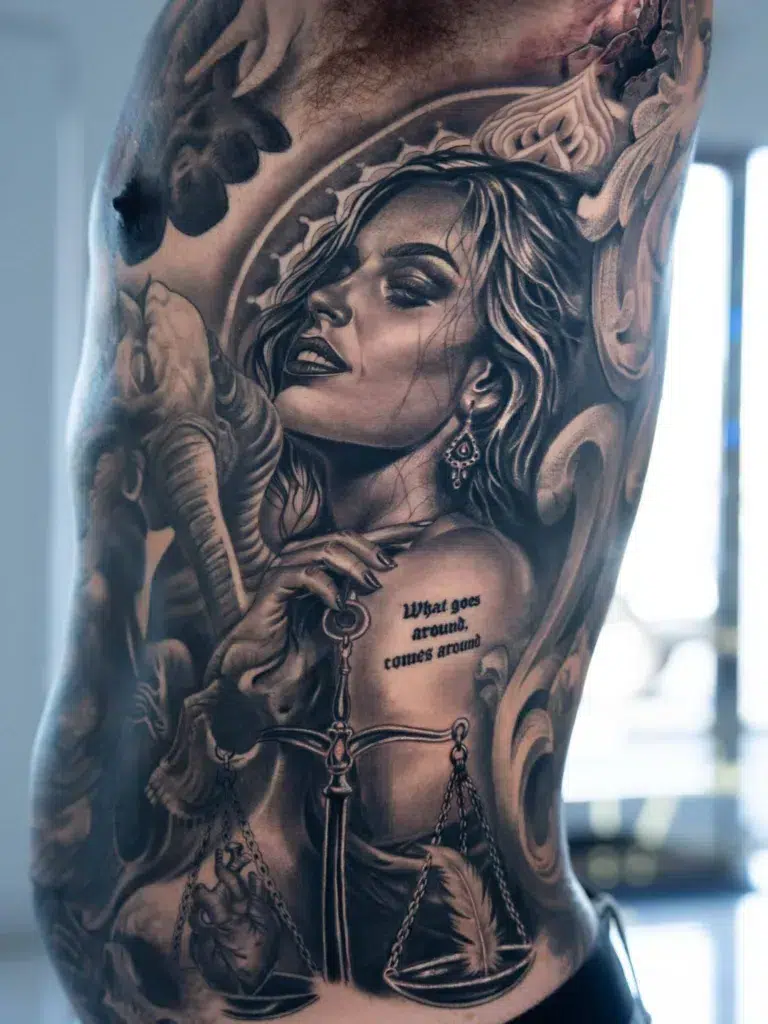
This piece took multiple sessions, due to detail and size. The process was expedited as it was a tattoo collaboration, so two artists worked simultaneously.
3. Style
Different tattoo styles have different technical demands—and those demands translate directly to time.
Black and grey realism: Requires multiple passes to build depth and tonal range. Among the most time-intensive styles per square inch.
Fine line: Precision-dependent. A single shaky line ruins hours of work. Artists work deliberately.
Traditional and neo-traditional: Bold lines and solid fills tend to move faster than realism or fine line.
Full color: Layering multiple colors to achieve saturation and smooth transitions takes time. Color work on larger pieces often requires more sessions than equivalent black and grey work.
Geometric and dotwork: Precision-heavy. Symmetry takes time to execute properly.
4. Placement
Where the tattoo sits on your body affects both how long it takes to complete and how long you can comfortably sit for the session.
Bony areas—ribs, shins, feet, spine, elbows—are more painful and cause more client movement and tension, which slows the artist down. Fleshy areas like the outer thigh or upper arm tend to be more comfortable, allowing longer uninterrupted sessions.
Placement also affects how the skin accepts ink. Some areas require more passes to achieve saturation.
5. Your Skin and Body's Response
Every body is different.
Some clients’ skin takes ink cleanly on the first pass. Others require multiple passes to achieve the same saturation. This isn’t a reflection of the artist’s skill—it’s physiology.
Similarly, your ability to sit still affects session length. An experienced artist can work quickly when the client is relaxed and stationary. Tension, flinching, and needing frequent breaks all extend the session.
6. The Artist's Process
Great artists don’t rush.
At a high-quality studio, time spent adjusting the stencil, reviewing placement, and making real-time design decisions during the session is part of the process—not wasted time. Artists who skip these steps to move faster are cutting corners that will show in the final result.
Honolulu tattoo artists Christina Choi & Robert Pho 1st Place in Black & Grey at the Golden State Tattoo Expo, after multiple sessions over time on this piece—text ‘HONOLULU’ to (702) 297-6079 to book your free consult.
Realistic Time Ranges by Tattoo Type
These are general ranges. Your artist will give you a more precise estimate after a consultation.
Small tattoos (palm-sized or smaller, minimal detail): 30 minutes to 2 hours
Medium tattoos (hand-sized to roughly A5 paper, moderate detail): 2 to 5 hours
Large single-session pieces (half sleeve, large back panel, full thigh): 5 to 8 hours in a single sitting, often split across multiple sessions
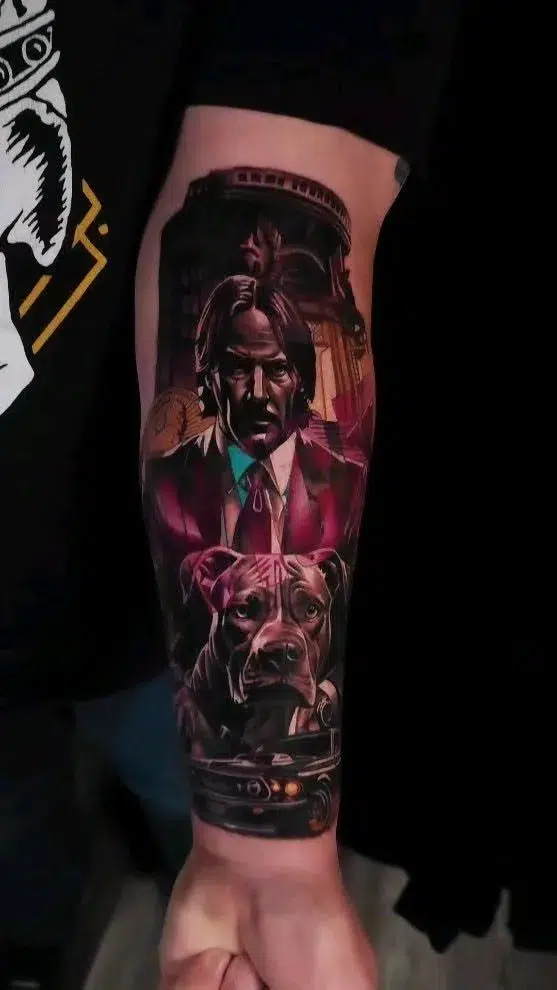
John Wick realism tattoo sleeve by Skin Design Tattoos’ resident artist in Nashville. This piece took two sessions. Check out his work and text ‘JAKE’ to book a free consultation on a custom design of your own.
Full sleeve: 15 to 40+ hours total, typically completed over multiple sessions spread weeks or months apart
Full back piece: 20 to 60+ hours total, depending on detail and style
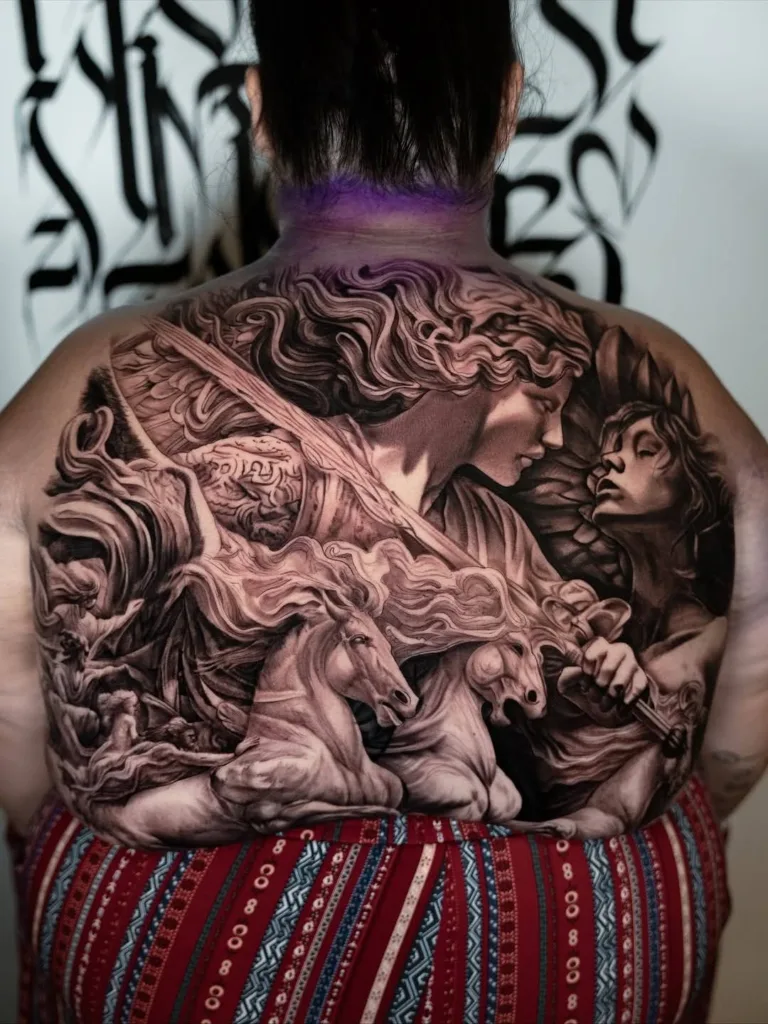
Full-back piece done by Las Vegas & OC tattoo artist Robert Pho—text us at 702-297-6079 to make your vision a reality
Portrait tattoos: 4 to 10 hours depending on size and complexity—portrait realism is technically demanding and shouldn’t be rushed
Fine line botanical or ornamental pieces: Varies widely. A small fine line piece might be 1 to 2 hours. A full forearm of detailed fine line work could be 6 to 10 hours.
Why Multi-Session Work Produces Better Results
There’s a misconception that completing a tattoo in one sitting is always preferable.
For small pieces, that’s often true. For anything large or complex, it isn’t.
Here’s why spreading sessions produces better work:
Skin fatigue. After several hours, skin becomes irritated and swollen. Ink doesn’t sit as cleanly in traumatized skin. Artists who push through on a fatigued canvas often end up with inconsistent saturation.
Artist fatigue. Precision work requires physical steadiness and mental focus. A great artist working hour ten of a difficult sleeve isn’t producing the same quality as they were at hour two.
Black and grey tattoo realism portrait tattoo by Skin Design’s very own Cat Castro (also featured on Ink Masters!)—click here to book your free consultation today
Design evolution. For large-scale compositions, working in stages lets the artist step back between sessions, assess the piece with fresh eyes, and make adjustments that improve the overall composition. The best large pieces are collaborative processes that benefit from time.
At Skin Design Tattoos, multi-session work is the standard for large custom pieces—because that’s how work that holds up over decades gets made.
What Happens During a Session
Understanding the full arc of a session helps set accurate time expectations.
Before the needle starts: Your artist will finalize the design, print the stencil, and position it on your body. This can take 20 to 45 minutes—sometimes longer for complex placements. Don’t rush this part. Proper placement is one of the decisions you can’t undo.
The tattoo itself: Depending on size and complexity, this is the bulk of the session. Most artists work in segments—completing one section before moving to the next—and will build in short breaks as needed.
Breaks: Longer sessions require breaks for both client and artist. For sessions over 4 hours, expect at least one meaningful pause to assess the work, let your skin settle, and reset your focus.
Wrap-up: Once the tattoo is complete, the artist will clean the area, photograph the fresh work, and walk you through aftercare. Budget another 15 to 20 minutes for this.
A 4-hour tattoo isn’t a 4-hour appointment. It’s a 5-to-5.5-hour commitment once setup and aftercare are factored in. Plan accordingly.
How to Prepare for a Long Session
Longer sessions are physically demanding. What you do before you sit down matters.
Eat a real meal beforehand. Not a snack—a full meal. Low blood sugar during a long session leads to lightheadedness, shakiness, and in some cases fainting. This is one of the most common issues studios deal with and it’s entirely preventable.
Stay hydrated. Well-hydrated skin accepts ink more easily. Drink water consistently in the days leading up to your session, not just the morning of.
Get enough sleep. Fatigue makes discomfort harder to manage. A client who’s well-rested sits better and tolerates longer sessions.
Wear comfortable clothing. Dress for access to the area being tattooed and for the likelihood of sitting or lying in one position for several hours. Tight waistbands, restrictive sleeves, and uncomfortable shoes all become problems over a long session.
Bring distractions. Headphones, a podcast, a book—whatever helps you mentally settle in. Long sessions are a mental endurance exercise as much as a physical one.
Don’t drink the night before. Alcohol thins the blood, causes the skin to bleed more during the session, and compromises ink saturation. It also increases sensitivity.
Healed and fresh black and grey leg sleeve by Christina Choi—took 5+ sessions total.
Common Questions About Tattoo Session Length
Can I split a large tattoo into shorter sessions?
Yes—and for most large-scale or complex pieces, this is the recommended approach. Multiple shorter sessions allow skin to recover fully between appointments, which typically produces better results than pushing through in a single marathon sitting. Your artist will help you map out a session plan during your consultation.
Does a faster artist mean a better artist?
No. Speed is a byproduct of experience in some cases, but it’s never the goal. An artist who prioritizes moving quickly over moving accurately is trading quality for time. The artists at Skin Design Tattoos work at the pace the piece demands—not faster.
Healed and fresh portrait tattoos by Lynn—send us a message to book yours today
Will my tattoo look different after it heals?
Yes, and this is important to understand before you judge the result. Fresh tattoos look sharp and saturated. After healing—typically two to four weeks—colors settle, contrast softens slightly, and the skin returns to its natural texture. This is normal. The healed result is the real result.
Does placement affect how long I can sit?
Significantly. Bony and high-nerve areas—ribs, spine, elbows, hands, feet—are substantially more uncomfortable and limit how long most clients can sit in a single session. If your planned piece is in one of these areas, build your session length expectations around your own tolerance, not just the design’s complexity.
Nature-themed realism tattoo by Las Vegas tattoo artist, Natalie Shaw. Text ‘SHAWTY’ to (702) 297-6079 for a free consult on a custom design
How far in advance should I book?
For custom work at a high-demand studio, plan for a wait. Artists with full books are booked weeks to months out. Starting the consultation process early gives you time to develop the design properly and secures your place in the artist’s schedule.
What if I need to stop mid-session?
It happens. If you’ve hit your limit—physically or mentally—communicate that to your artist. A good artist will always prefer to pause and finish in a follow-up session over pushing through on a client who isn’t in the right headspace to sit. The work suffers when a client is struggling.
Why the Right Studio Makes the Time Worth It
How long a tattoo takes is really a secondary question.
The primary question is: will this tattoo still look exceptional in ten years?
The answer to that depends entirely on the artist and the process—not the clock.
At Skin Design Tattoos, every session is structured around the work. Session timelines are set after a real consultation, not guessed at over the phone. Artists specializing in black and grey realism, fine line, and large-scale compositions work at the pace those styles demand—because that’s how the work holds up.
Founder Robert Pho has built the studio’s philosophy around a simple principle: design with intention, execute with discipline, prioritize longevity. That standard applies to every session, regardless of how long it takes.
If you’re ready to start the process—whether you’re planning a small first piece or a full sleeve—the first step is a consultation.
Text 702-297-6079 to book yours.
We have studios in:
FAQ
How long does a small tattoo take?
Most small tattoos—palm-sized or smaller with minimal detail—take between 30 minutes and 2 hours. Very simple designs like small script or minimal line work can be completed in under an hour. More intricate small pieces, like a detailed fine line design, can take closer to 2 to 3 hours.
How long does a sleeve tattoo take?
A full sleeve typically requires 15 to 40 or more total hours, spread across multiple sessions. Half sleeves generally run 8 to 20 hours. The exact total depends heavily on the style, level of detail, and how your skin responds. Most sleeve clients complete their work over the course of several months to a year or more.
How long does a back tattoo take?
A full back piece is among the most time-intensive tattoos, often requiring 20 to 60+ hours across multiple sessions. Even a large upper or lower back panel may require 10 to 20 hours depending on detail and style.
How long does a portrait tattoo take?
Portrait tattoos are technically demanding—they require careful shading, tonal accuracy, and consistent detail throughout. Expect 4 to 10 hours for a portrait, depending on size and complexity. Larger portrait pieces, or those with detailed backgrounds, will sit at the higher end.
Can I get a tattoo done in one day?
Smaller and medium pieces, yes. For anything requiring more than 6 to 8 hours of work, most experienced artists recommend splitting sessions to protect skin quality and give the artist optimal conditions throughout. A one-day rush on a large piece is one of the most common contributors to work that doesn’t age well.
How do I get an accurate time estimate?
Book a consultation. There’s no substitute for an artist reviewing your design, your placement, and your goals in person. Estimates given without that context are guesses, not plans.
Skin Design Tattoos has studios in Honolulu (Hawaii), Brooklyn (New York), SoHo (New York), Orange County (California), Nashville (Tennessee), and Las Vegas (Nevada). Text 702-297-6079 to start your consultation.