

How to Choose a Tattoo Artist: What Actually Matters
Learning how to choose a tattoo artist is the most important step in getting a great tattoo. Here’s what to look for—and what to ignore.
Key Takeaways
- How to choose a tattoo artist starts with identifying the style you want—not finding the closest or cheapest option
- Style specialization is the single most important factor in artist selection; generalists rarely produce specialist-level results
- Healed portfolio work is a more honest measure of quality than fresh tattoo photos
- A genuine consultation process is a baseline requirement for any custom work—not an optional extra
- Online reviews provide social proof but tell you little about technical quality; portfolios are the primary evaluation tool
- Proximity and price are the two factors that matter least in the long run
- Red flags in the search process are as important as green ones—knowing what to avoid is half the decision
- Skin Design Tattoos structures every client engagement around the factors that actually produce lasting results
The Decision That Shapes Everything Else
Every other tattoo decision—design, placement, size, style—depends on this one.
Choose the wrong artist and none of the rest of it matters. A great design executed poorly produces a result you’ll spend years trying to fix or forget. A simple design executed by the right artist produces something you’ll still appreciate in twenty years.
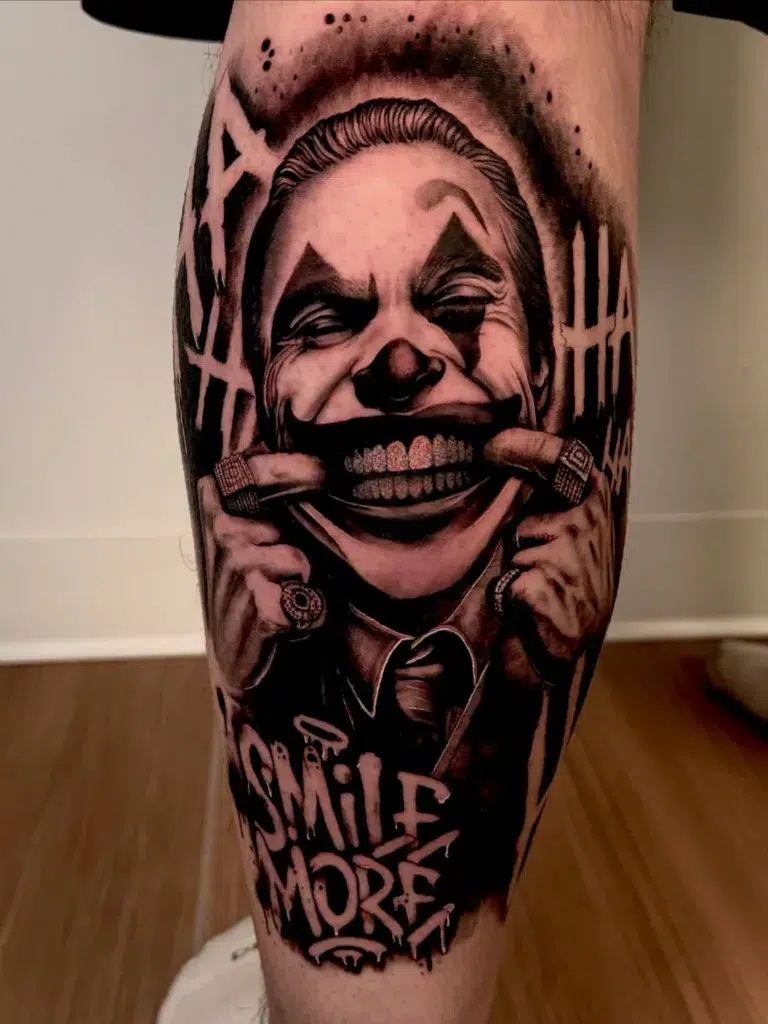
Healed and fresh black and grey leg sleeve by award-winning Honolulu tattoo artist Christina Choi—text ‘CHRISTINA’ to (702) 297-6079 for a free consult
Knowing how to choose a tattoo artist isn’t about finding the most famous name or the most followers. It’s about identifying the person with the right combination of skills, specialization, and process for the specific tattoo you want.
This guide breaks down exactly what that looks like—what to prioritize, what to look past, and what to walk away from.
Step One: Know What You Want Before You Start Looking
The most common mistake in artist selection is starting with the artist before establishing what you want.
This produces one of two outcomes: you find an artist you like and then shape your tattoo around what they do, or you find someone willing to do anything you ask regardless of whether they’re actually suited to it.
Neither produces the best result.
The right sequence is:
- Identify the style you’re drawn to
- Find artists who genuinely specialize in that style
- Select from that shortlist based on consultation, portfolio quality, and fit
Style is the filter. Everything else is secondary to it.
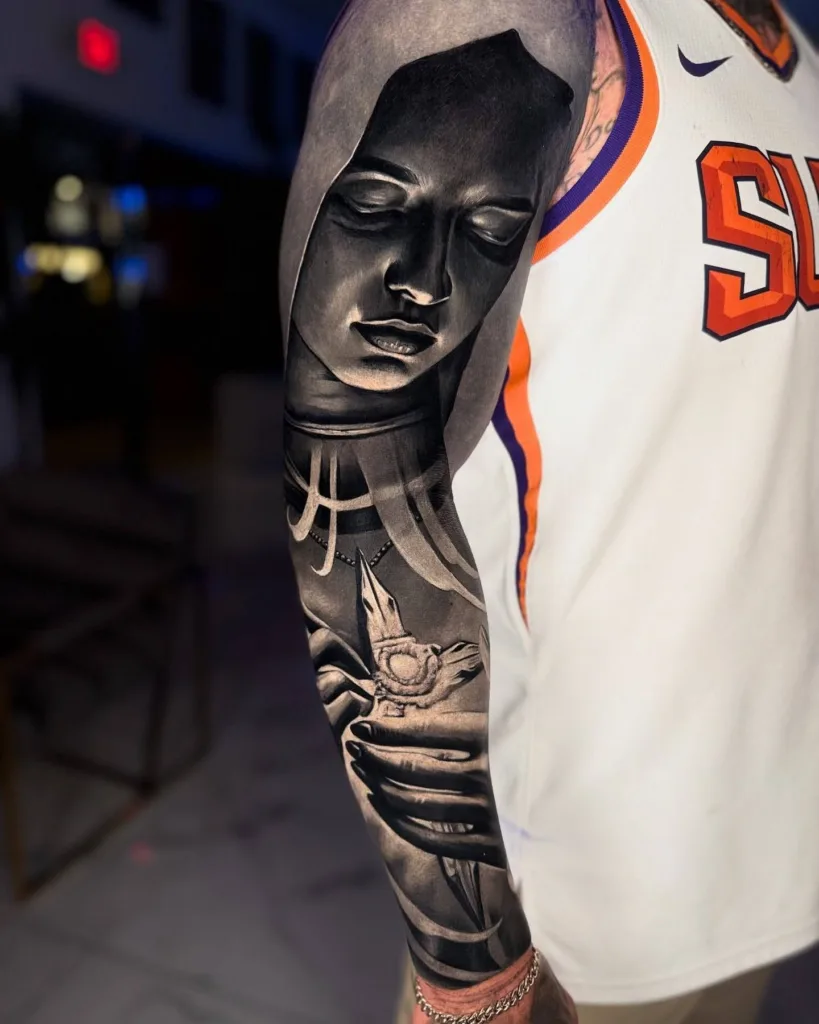
Fully healed black and grey realism tattoo by award-winning OC & Las Vegas tattoo artist—and founder of Skin Design Tattoos—Robert Pho
If you’re not sure what style you want, spend time building a reference folder—collect images from Instagram, Pinterest, and tattoo studio websites that consistently catch your eye. Look for the common thread. Are they bold and graphic? Delicate and precise? Photorealistic? Illustrative? That thread is your style direction.
The Most Important Factor: Specialization
This deserves its own section because it’s the factor most people underweight.
Tattoo artists who specialize produce fundamentally different work than generalists. Not slightly different—fundamentally different.
An artist who has spent five to ten years focusing specifically on black and grey realism has developed technical depth in that style that a generalist simply cannot replicate. The same is true for fine line, traditional Japanese, portrait work, geometric, and every other style that rewards specialized practice.
When an artist’s portfolio shows consistent excellence across one or two styles, that’s specialization. When it shows a scattered mix of every style with no consistent level of quality, that’s a generalist. Both types of artists exist. Only one is the right choice for a specific style of work.
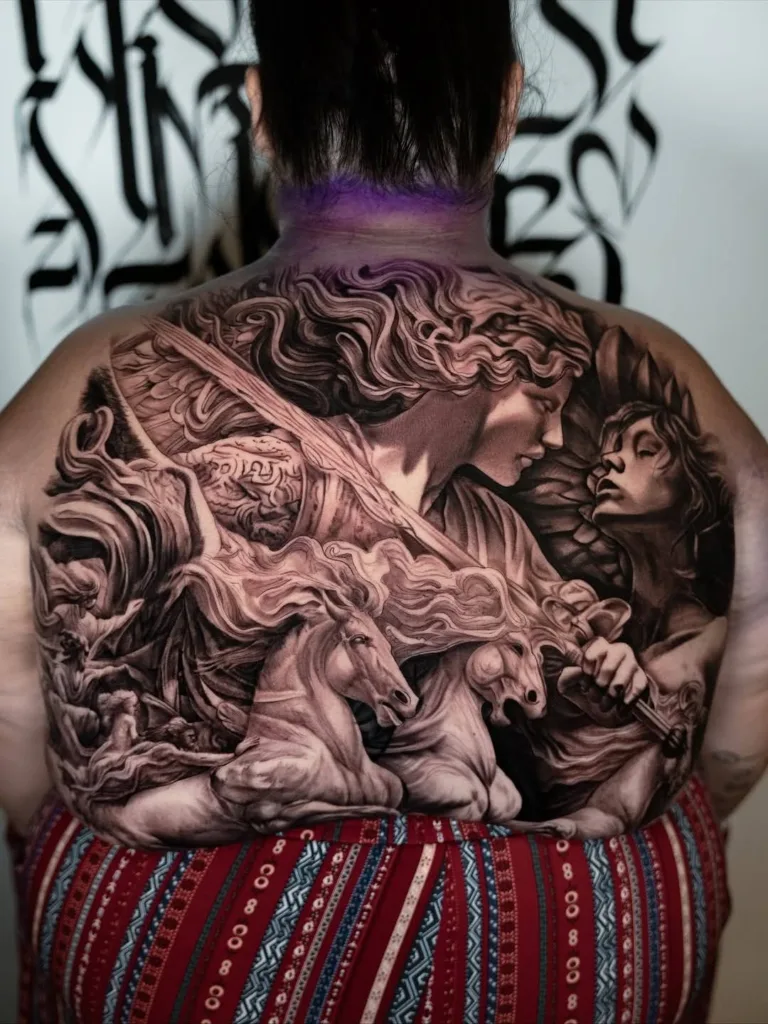
Fresh, full-back piece done by Robert Pho—text us at 702-297-6079 to make your vision a reality
An artist who has spent five to ten years focusing specifically on black and grey realism has developed technical depth in that style that a generalist simply cannot replicate. The same is true for fine line, Japanese traditional, portrait work, geometric, and every other style that rewards specialized practice.
When an artist’s portfolio shows consistent excellence across one or two styles, that’s specialization. When it shows a scattered mix of every style with no consistent level of quality, that’s a generalist. Both types of artists exist. Only one is the right choice for a specific style of work.
How to identify genuine specialization:
- The majority of the artist’s portfolio is in one or two styles
- The quality within those styles is consistent—not just occasionally strong
- The artist can speak knowledgeably and specifically about the technical demands of that style when asked
- They have healed work in that style to show
An artist who claims to do everything equally well almost certainly doesn’t.
Fresh tattoo (left) vs. healed tattoo (right) by renowned tattoo artist Robert Pho
How to Evaluate a Portfolio
The portfolio is the primary evidence. Here’s how to read it correctly.
Look for Healed Work—Not Just Fresh
This is the most important portfolio evaluation principle and the one most people skip.
Fresh tattoos look good almost by default. Ink is saturated, skin is undisturbed, and the work is at its most vivid. Fresh photos show you what the artist can produce in ideal conditions. Healed photos show you what that work looks like on real skin after the skin has done what skin does.
When evaluating an artist, always ask specifically to see healed tattoo photos.
In healed work, look for:
- Consistent contrast that hasn’t faded unevenly or blown out
- Clean line work that has retained its integrity rather than blurring or spreading significantly
- Smooth shading that reads as even and intentional rather than patchy
- Readable composition that still holds together without the benefit of fresh ink
An artist who can’t provide healed examples—or who only shows fresh work—is an artist who hasn’t earned confidence in their healed results.
Healed payasa portrait leg sleeve in black and grey ink by Honolulu tattoo artist Sandra
Look for Consistency, Not Just Peaks
A portfolio with three exceptional pieces and twenty mediocre ones is not the portfolio of an artist who consistently produces exceptional work. It’s the portfolio of an artist who occasionally does.
Look for the floor, not the ceiling. Is the weakest work in the portfolio still strong? That tells you what you’ll reliably get. Peaks tell you what’s possible on a good day.
Cherry blossom mastectomy tattoo done by Lynn Hoang—reach out for a free consultation today
Look for Work Similar to What You Want
This sounds obvious and gets skipped constantly.
If you want a portrait tattoo, evaluate the artist’s portrait work specifically. If you want fine line botanical work, evaluate their fine line botanical work specifically. An artist who excels in bold traditional work and also offers fine line is not a fine line specialist—they’re a traditional specialist who also does fine line.
Match the evaluation to the specific request. Don’t generalize from strength in one area to competence in another.
Text ‘STORM’ to 702-297-6079 or book via inkquiries.com/storm
Scale and Complexity Progression
Artists who take on increasingly ambitious work—larger compositions, more complex subjects, more technically demanding styles—and show consistent quality across that progression are artists who are actively developing their craft. This is a good sign.
An artist whose portfolio shows the same scale and complexity year after year may not be pushing their technical development in ways that will translate to the best possible result on a challenging piece.
Black and grey tattoo realism portrait tattoo by Skin Design’s very own Cat Castro (also featured on Ink Masters!)—click here to book your free consultation today
The Consultation: What It Tells You
A consultation isn’t just logistical—it’s diagnostic.
How an artist conducts a consultation tells you a significant amount about how they’ll approach your tattoo. The right consultation involves:
Questions about your vision. An artist who asks thoughtful questions about what you want, why you want it, and what references you’ve brought is engaging with your project. An artist who barely listens and jumps to booking is engaging with the transaction.
Honest guidance on sizing and placement. A good artist will push back if your sizing is too small for the design to hold detail. They’ll recommend placement adjustments if the original choice compromises how the work will age. This pushback is a feature, not a problem—it means the artist is invested in the outcome rather than just the session.
Realistic expectations about the process. How many sessions will this require? What will healing look like? What aftercare is specific to this placement and style? An artist who walks you through this in detail is one who prioritizes the client’s understanding over their own convenience.
Willingness to say no. The best artists occasionally decline work that isn’t suited to their strengths or that a client’s expectations don’t align with what’s achievable. An artist who agrees to everything regardless of fit is an artist who prioritizes the booking over the result.
If you leave a consultation feeling informed, heard, and guided—rather than sold to—that’s a good sign.
Red Flags to Walk Away From
Knowing what to avoid is as important as knowing what to look for.
No Healed Work in the Portfolio
Every photo is fresh. There are no healed examples to be found. This suggests the artist either hasn’t tattooed long enough to have healed work or doesn’t feel confident showing it. Neither is acceptable for a serious custom project.
Willingness to Book Without a Consultation
For custom work, a studio that books you directly—no conversation about design, no discussion of placement or sizing—is a studio that isn’t approaching the work with the care it requires. Flash tattoos from an established design may not need a formal consultation. Custom work always does.
Fully healed cherub tattoo by Skin Design Tattoos Honolulu tattoo artist—text ‘SANDRA’ to (702) 297-6079 to start your next piece
Dramatically Below-Market Pricing
Significant undercutting of standard market rates is not a deal—it’s a signal. Experienced, specialized artists price their work to reflect their skill and time. Pricing far below what comparable studios charge reflects either inexperience, a compromised process, or both. The permanent nature of the medium makes this the wrong place to seek the lowest price.
Pressure to Book Immediately
Quality artists have waitlists. Their books fill because demand for their work is genuine. An artist or studio applying pressure to commit before you’ve had time to do proper research is compensating for something. The right studio is confident enough in its work to let you take the time you need.
Healed black and grey tattoo design by Skin Design Tattoos Hawaii artist Lynn Hoang—text ‘LYNN’ to (702) 297-6079 to book
Inconsistent Portfolio Quality
As covered above—significant quality variation across a portfolio is not a sign of range. It’s a sign of inconsistency. You cannot reliably predict which version of the artist you’ll get.
No Clear Specialization
An artist who offers every style equally—traditional, realism, fine line, watercolor, geometric, blackwork—is an artist who has gone broad rather than deep. Breadth without depth produces average results across the board. For anything beyond the most basic work, specialization is what you’re paying for.
Dismissiveness About Your Questions
If an artist or studio makes you feel uncomfortable for asking about pricing, healing, touch up policies, or healed portfolio examples—that’s a serious red flag. These are reasonable questions that any professional studio should answer without hesitation.
Fully healed full color realism tattoo (done in 2024) by Skin Design Tattoos Las Vegas tattoo artist Brad Charles—text ‘BRAD’ to (702) 297-6079 to book. Proof that tattoos built well & protected from the sun will hold up over time.
What to Do With Online Reviews
Reviews are useful as social proof—they tell you that other clients had a broadly positive experience. They are not a substitute for portfolio evaluation.
A five-star review from a happy client tells you the experience was positive. It doesn’t tell you whether the work held up over time, whether the sizing decision was right, or whether the artist’s technical execution matches their reputation.
Use reviews to:
- Replace portfolio evaluation as the primary quality indicator
- Determine whether an artist is the right fit for your specific style
The portfolio is the evidence. Reviews are context.
Don’t use reviews to:
- Replace portfolio evaluation as the primary quality indicator
- Determine whether an artist is the right fit for your specific style
The portfolio is the evidence. Reviews are context.
Instagram and Social Media: How to Use It Properly
Most people find tattoo artists through Instagram. There’s nothing wrong with this—it’s where much of the best contemporary tattoo work is shared.
The caution is that Instagram optimizes for what performs visually, not what lasts technically. Dramatic, high-contrast fresh tattoos perform well on Instagram. Healed work—which often looks less dramatic but reflects actual quality—appears less frequently.
When evaluating artists on Instagram:
- Look for tagged healed photos in their posts or highlights
- Check the comments for client feedback on healed results
- Notice whether the portfolio shows depth in a specific style or scatters broadly
- Look at how long the artist has been posting and how the work has developed—or hasn’t
Artists with genuinely strong healed portfolios are not hiding them. They’re proud of them. Look specifically.
The Question of Price
Price should be the last factor in the evaluation, not the first.
This doesn’t mean ignore it—it means put it in context.
A tattoo is one of the only things you buy that you genuinely cannot return, exchange, or easily undo. The cost of living with work that doesn’t meet the standard you wanted—financially and otherwise—consistently exceeds the difference between a quality studio and a cheaper one.
The right question isn’t “who is the least expensive option?” It’s “what is the correct investment for the result I want, and can I make that work?”
Black and grey realism tattoo sleeve after tattoo touch up by New York tattoo artist Mando—text (702) 298-6079 to book
For clients where the total cost of a significant piece is a genuine barrier, financing through Affirm and Klarna at Skin Design Tattoos makes it possible to work with the artist and studio that’s actually right for the project—without compromising on quality to fit a single-payment budget. Payment plans run up to 24 months at skindesigntattoos.com/financing/
Putting It Together: A Practical Checklist
Before committing to any tattoo artist, work through this:
Style fit:
- Does the artist’s portfolio show consistent strength in the style I want?
- Have they produced work at a similar scale and complexity to what I’m planning?
Portfolio quality:
- Have I seen healed examples of their work—not just fresh photos?
- Is the quality consistent, or does it peak and valley?
Consultation:
- Did the artist ask questions and engage with my vision?
- Did they offer honest guidance on sizing and placement, including pushback where relevant?
- Did I leave the consultation feeling informed rather than sold to?
Professionalism:
- Did the studio communicate clearly and promptly?
- Were my questions about pricing, process, and touch up policy answered directly?
- Does the studio environment feel clean and organized?
No red flags:
- Is there healed work in the portfolio?
- Is there a consultation process for custom work?
- Is the pricing in a realistic range for the style and artist experience level?
- Is there no pressure to commit before I’m ready?
If the answers to these questions are consistently yes, you’ve found the right artist.
Award-winning black and grey realism tattoos by Skin Design Tattoos OC artists
FAQ
How do I find a good tattoo artist?
Start by identifying the style you want, then search specifically for artists whose portfolios are built around that style. Look at healed work, not just fresh photos. Book a consultation and pay attention to how the artist engages—thoughtful questions, honest guidance, and informed pushback are all positive signs. Don’t lead with proximity or price.
What should I look for in a tattoo artist's portfolio?
Healed examples of work in the style you want, consistent quality across the portfolio rather than just occasional peaks, and work at a similar scale and complexity to what you’re planning. The floor of the portfolio—not the ceiling—tells you what you’ll reliably get.
Is it okay to ask to see healed tattoo photos?
Not only okay—it’s necessary. Any reputable artist will be able to show healed examples of their work and will understand exactly why you’re asking. Artists who can’t provide healed photos or who seem reluctant to show them are not artists whose healed results you should be confident in.
How important is it that an artist specializes in a specific style?
It’s the most important factor in the selection process. Specialization produces technical depth that generalism can’t replicate. An artist who has spent years focused on black and grey realism, fine line, Japanese traditional, or any other style will produce fundamentally better work in that style than one who offers everything equally.
Should I choose a tattoo artist based on price?
Price should be the last evaluation factor, not the first. The cost of living with work that doesn’t meet your expectations—permanently—consistently exceeds the difference between a quality artist and a less expensive one. Understand what fair market pricing looks like for the style and artist experience level you’re considering, and treat significant deviation below that as a warning sign rather than a deal.
What questions should I ask a tattoo artist before booking?
Can I see healed examples of work in my style? What size do you recommend for this design and why? What does the consultation process involve? How many sessions will this require? What is your touch up policy? How will healing look for this placement? An artist who answers these questions thoroughly and without pressure is one worth trusting.
How do I know if a tattoo artist is right for me specifically?
The consultation is the clearest indicator. Did the artist engage with your specific vision or give generic responses? Did they offer informed guidance on sizing and placement? Did they ask questions about what you want and why? Did you leave the conversation feeling more confident in the project? If yes across the board, the fit is likely right.
What are the biggest mistakes people make when choosing a tattoo artist?
Leading with price or proximity rather than style fit. Evaluating portfolios based on fresh photos rather than healed work. Not booking a consultation before committing. Choosing an artist who offers every style over one who genuinely specializes. Ignoring red flags—inconsistent portfolio quality, no consultation process, pressure to book immediately—because the artist’s social media presence is impressive.
Ready to Find the Right Artist?
The process of finding the right tattoo artist is more straightforward than it feels—when you know what to look for.
At Skin Design Tattoos, every artist has a defined specialization, every custom project starts with a real consultation, and every client leaves with an honest picture of what the process involves before any commitment is made. If you want to talk through what you’re looking for and find the right fit within our team, the consultation is the place to start.
Skin Design Tattoos has tattoo shops in:
Text 702-297-6079 to book your free consultation.
Or start online at skindesigntattoos.com/tattoo-consultation/
Financing available through Affirm and Klarna—payment plans up to 24 months at skindesigntattoos.com/financing/