

Real Tattoo Sleeve Ideas & Expert Planning for a Sleeve You’ll Love for Life
Key Takeaways
- Tattoo sleeve ideas are only as good as the planning behind them—a sleeve designed from the start looks fundamentally different from one assembled piece by piece
- The most important decision in any sleeve isn’t the first tattoo—it’s the overall compositional concept
- Style consistency is what separates a cohesive sleeve from a collection of unrelated tattoos
- Full sleeves typically require 20 to 40+ hours across multiple sessions; half sleeves run 10 to 20 hours
- Negative space is a design element, not empty space waiting to be filled
- Certain styles—Japanese traditional, black and grey realism, neo-traditional—are naturally suited to sleeve format
- Flow, transition, and anchor pieces are the structural foundations every sleeve needs
- Trying to save money on a sleeve is one of the most expensive decisions you can make long-term
- Skin Design Tattoos plans and executes sleeves as unified compositions—not session-by-session accidents
Why Tattoo Sleeves Go Wrong Without a Plan?
Look at enough tattoo sleeves and you’ll notice a clear divide.
Some sleeves look like a single piece of art wrapping the arm: cohesive, intentional, everything in conversation with everything else.
Others look like a storage unit. Every tattoo technically fits, but nothing belongs together. Different scales, different styles, different line weights. The arm reads as chaotic rather than composed.
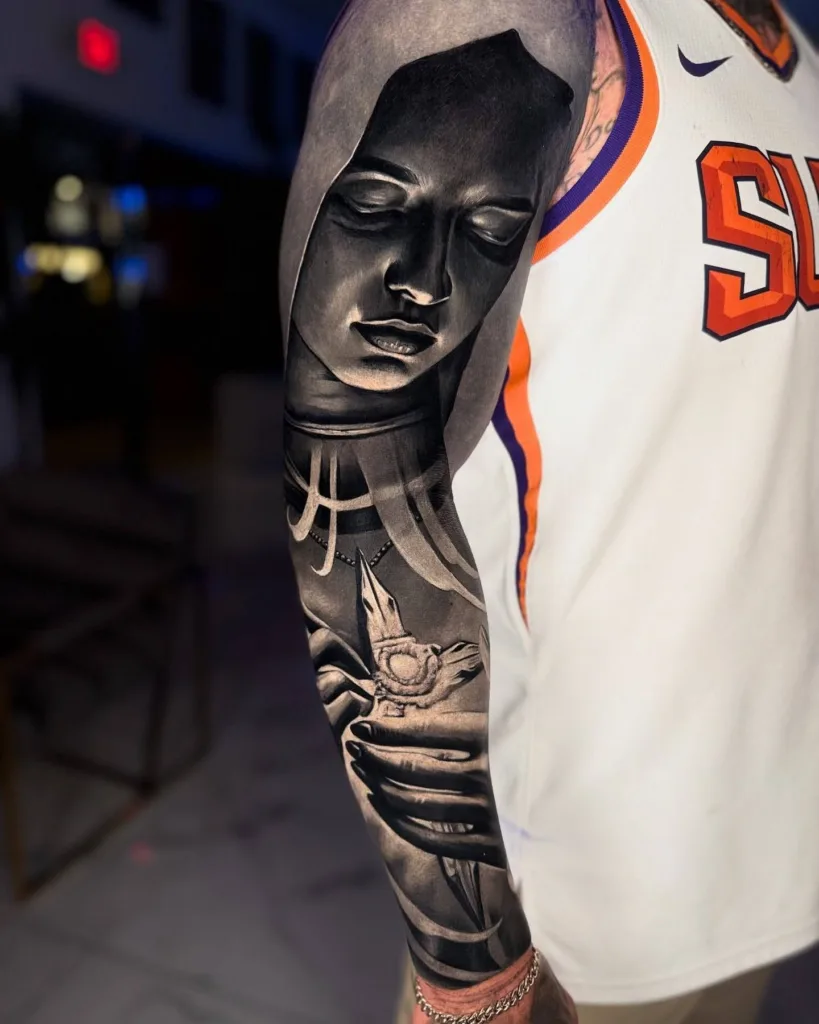
Black and grey realism tattoo sleeve by New York tattoo artist Mando—text (702) 298-6079 to book
The difference almost never comes down to the quality of individual tattoos. A sleeve that doesn’t work is usually full of tattoos that would look fine on their own. The problem is that they were never planned to coexist.
This guide is about avoiding that outcome. Whether you’re starting from scratch or working around existing ink, here’s how to approach tattoo sleeve ideas the way studios that produce exceptional work actually approach them—with the whole composition in mind from the beginning.
Healed payasa portrait leg sleeve in black and grey ink by Honolulu tattoo artist Sandra
Plan Your Tattoo Sleeve as One Complete Composition
The most important conceptual shift in sleeve planning is this: a sleeve is not a collection of tattoos. It’s one tattoo that happens to require multiple sessions.
When a sleeve is treated as a collection, you get something assembled. When it’s treated as a composition, you get something unified.
At Skin Design Tattoos, sleeve consultations begin with the full arm—not the first session. The entire composition is mapped before a needle touches skin. That map determines where anchor pieces go, how elements flow from shoulder to wrist, what connects them, and how much negative space the design needs to breathe.
This takes more time upfront. It produces an entirely different result.
Tattoo Sleeve Ideas by Style
Style is the most consequential decision in sleeve planning. It determines the visual language of the entire arm—line weight, shading approach, color palette, and how different elements relate to each other.
Mixing styles in a sleeve is possible but technically demanding. Style consistency is the default for a reason: it’s what makes a sleeve read as unified rather than assembled.
Here are the styles best suited to sleeve format and what makes each one work.
Japanese Traditional (Irezumi)
Japanese traditional tattooing was developed with large-scale body coverage in mind. The compositional vocabulary of irezumi—flowing water, clouds, wind bars, flowers, waves—was specifically designed to connect individual elements across broad surface areas and to move with the body rather than sit flat against it.
This is why Japanese sleeves tend to work so naturally. The style comes pre-equipped with the connective tissue a sleeve needs.
Classic Japanese sleeve elements:
- Dragons and koi as anchor pieces—large-scale, directionally dynamic
- Cherry blossoms, peonies, and chrysanthemums as supporting floral elements
- Waves and water as transitional flow between larger pieces
- Wind bars and clouds as negative space management
- Tigers, phoenixes, and foo dogs as secondary anchors
A Japanese sleeve has an internal logic that makes planning more intuitive than many other styles. The challenge is finding an artist who genuinely specializes in the style rather than one who can approximate it. Japanese traditional done poorly is immediately recognizable—the balance between bold line, fill, and background is specific and unforgiving.
Black and Grey Realism
Black and grey realism sleeves are among the most technically demanding and visually striking compositions in tattooing.
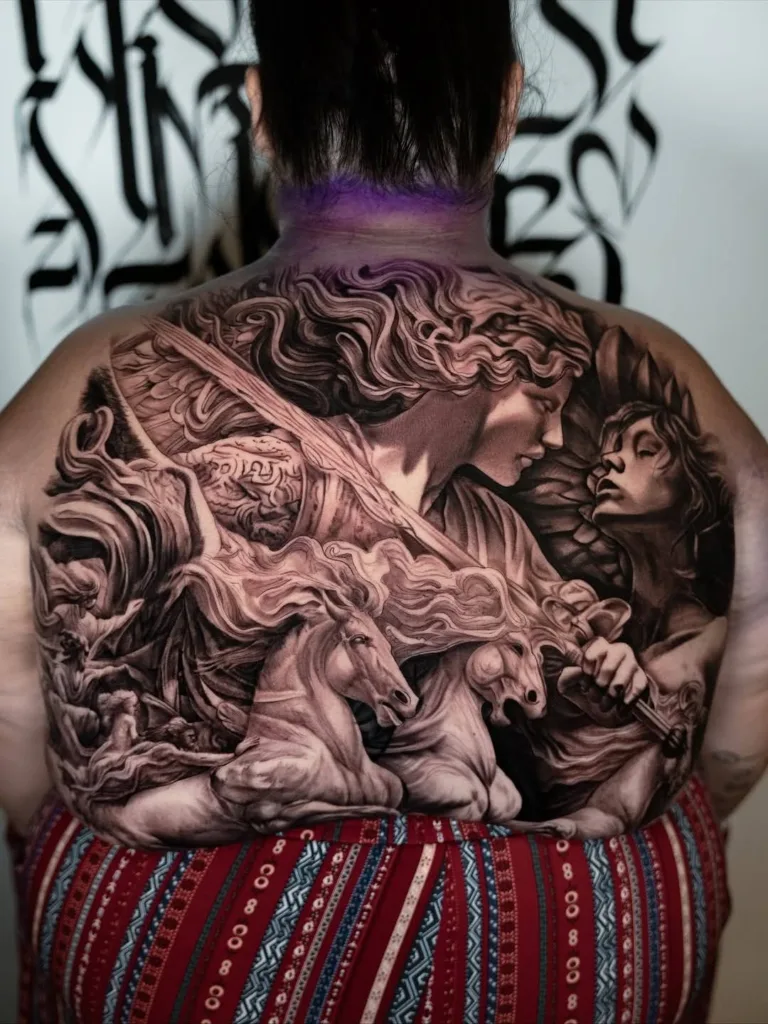
The style allows for genuine variety within a unified palette—portraits, animals, landscapes, architectural elements, abstract shading—all rendered in the same tonal language. This makes it naturally adaptable to sleeve format: a portrait on the upper arm, an animal study on the forearm, atmospheric shading connecting them, all reading as one piece.
Black and grey sleeve concepts that work well:
- Memorial sleeves combining portraiture with symbolic nature elements
- Wildlife compositions—eagle to wolf, or a single animal rendered across multiple panels
- Dark surrealism or horror-influenced work with consistent atmospheric shading
- Nature and botanical compositions built around a central realistic element
- Mixed figurative and abstract work unified by consistent shading approach
Healed black and grey tattoo design by Skin Design Tattoos Hawaii artist Lynn Hoang—text ‘LYNN’ to (702) 297-6079 to book
The requirement: an artist with deep, demonstrated expertise in black and grey realism specifically. Tonal consistency across a full sleeve—across multiple sessions, over months or years—is one of the hardest technical challenges in tattooing. Always evaluate healed work before committing.
Neo-Traditional
Neo-traditional combines the structural integrity of traditional tattooing—bold line weight, solid fills—with a more illustrative sensibility, a wider color palette, and more complex shading.
The result is a style that ages reliably (the bold lines hold the composition together as color naturally softens over time) while offering more visual complexity than strict traditional.
Neo-traditional sleeves work particularly well when built around a central theme—flora and fauna, celestial elements, art nouveau-influenced botanicals—that gives the varied elements a conceptual through-line.
Neo-traditional sleeve directions:
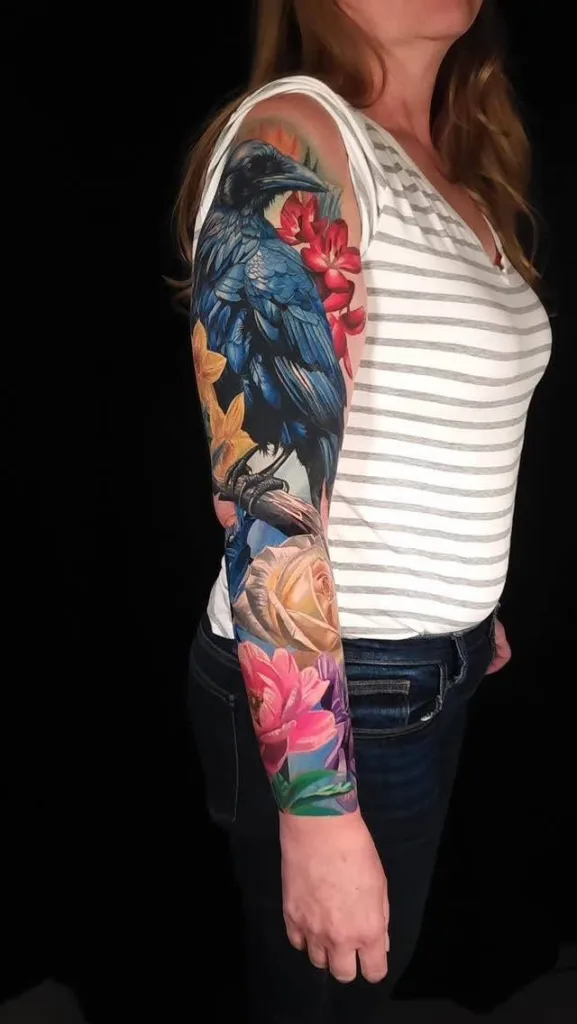
- Botanical sleeves with rich floral elements in deep, jewel-toned color
- Animal-focused sleeves with expressive, illustrative rendering
- Celestial or occult-influenced work with consistent decorative vocabulary
- Portrait-adjacent work that retains illustrative expressiveness over strict realism
Traditional American
Classic American traditional—bold black outlines, a limited palette of primary colors, iconic imagery—is one of the most durable sleeve formats available.
The visual consistency of the style makes it naturally suited to sleeve composition. Every element shares the same line weight and fill approach, so cohesion is built into the format. A traditional sleeve assembled over years by the same or different artists in the same style still reads as unified.
Traditional sleeves also age more reliably than most formats. The bold outlines that define the style resist the blurring and softening that affects finer work over time.
Traditional sleeve elements:
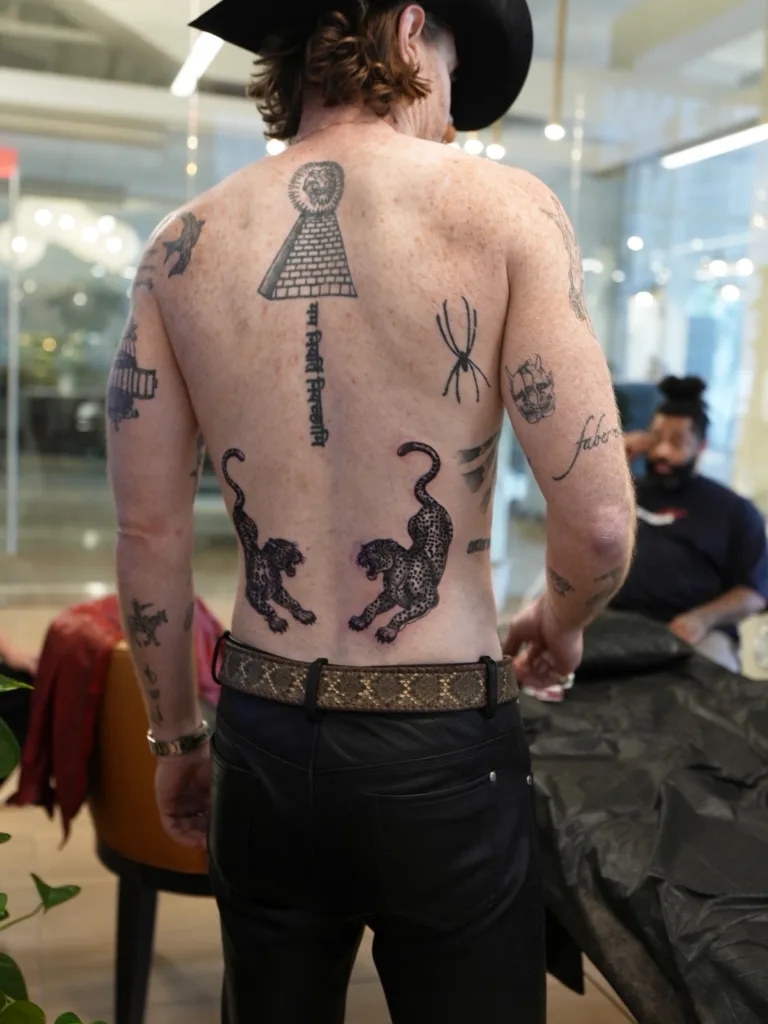
- Eagles, panthers, snakes, swallows as anchor pieces
- Roses, daggers, anchors, and banners as supporting elements
- Bold script lettering as connective or standalone elements
- American flags, ships, pin-ups as thematic anchor pieces
Fine Line and Ornamental
Fine line sleeves—delicate, precise, low-saturation—represent a more recent but increasingly established sleeve format, particularly popular for those who want substantial coverage with a light visual presence.
Ornamental fine line sleeves often incorporate mandala-influenced patterning, botanical linework, geometric elements, and negative space as an active compositional tool. The arm reads as adorned rather than covered.
Important consideration: fine line sleeves require more disciplined long-term maintenance than bold styles. Sun protection is non-negotiable—UV exposure degrades fine linework faster than it does heavier work. Touch-up sessions are a more regular part of maintaining a fine line sleeve’s crispness over time.
This doesn’t make fine line sleeves a poor choice—it makes them a choice that benefits from being made with full information.
The Anatomy of a Well-Planned Sleeve
Regardless of style, every successful sleeve shares the same structural elements.
Anchor Pieces
An anchor piece is the compositional centerpiece of a sleeve segment—the element with the most visual weight, the largest scale, and the clearest focal point.
Most sleeves have two to three anchor pieces: typically one on the upper arm (often around the shoulder or bicep), one at the forearm, and sometimes one at or around the elbow.
Anchor pieces don’t have to be the largest elements in total area—they need to be the strongest compositionally. Everything else in the sleeve is organized around them.
Planning anchor placement before starting any sessions is one of the most impactful decisions in sleeve design. An anchor placed without considering what surrounds it creates a sleeve that doesn’t flow.
Connective Elements
Connective elements are what turn a set of anchor pieces into a sleeve.
In Japanese work, this is often water, clouds, or wind bars. In black and grey realism, it’s atmospheric shading or secondary nature elements. In neo-traditional, it’s floral and foliate detail that fills and bridges.
The connective tissue is often the difference between a sleeve that looks finished and one that looks like individual tattoos that happen to be near each other.
Best of show full color leg sleeve at the 2025 Hawaii Tattoo Expo by Skin Design Tattoos’ Honolulu’s award-winning artists, Christina Choi & Lynn Hoang
Negative Space
Negative space—skin left intentionally untouched—is a design element, not an absence of design.
Sleeves with no negative space tend to feel visually heavy and lose readability as the tattoos age and ink naturally softens. Sleeves with well-managed negative space breathe. The untouched skin creates contrast that makes the tattooed elements read more clearly.
This is one of the most common planning mistakes in sleeves built piece by piece without an overall composition in mind: negative space gets filled reactively rather than used intentionally.
Flow and Directionality
A sleeve should have directional energy—a sense of movement that pulls the eye through the composition.
This is achieved through the orientation of major elements, the direction of connective elements like water or wind, and the diagonal or spiral organization of the overall composition. A sleeve with strong flow reads as dynamic even when the arm is still. A sleeve without it reads as static regardless of how strong individual elements are.
Half Sleeve vs. Full Sleeve: What to Know Before You Decide
Half Sleeve
A half sleeve covers either the upper arm (shoulder to elbow) or the lower arm (elbow to wrist).
Upper arm half sleeve: More easily concealed, less painful on average, and a strong standalone composition that can be extended later. A natural starting point for people planning a full sleeve over time.
Lower arm half sleeve: More visible, more immediately present in daily interactions. The forearm is one of the most scrutinized placements—quality is always on display. Strong lower arm sleeves tend to incorporate the wrist naturally rather than stopping abruptly.
Half sleeves typically require 10 to 20 hours across multiple sessions depending on style and detail.
John Wick realism tattoo sleeve by Skin Design Tattoos’ resident artist in Nashville. Check out his work and text ‘JAKE’ to book a free consultation on a custom design of your own.
Full Sleeve
A full sleeve runs shoulder to wrist and is one of the most ambitious personal commitments in tattooing.
Total time investment: typically 20 to 40+ hours across multiple sessions spread over months to sometimes more than a year. The variation depends heavily on style—a dense Japanese color sleeve at the high end of that range is a fundamentally different undertaking from a looser black and grey composition.
The most important thing to understand about full sleeves: they reward starting with a plan even more than half sleeves do. An upper arm half sleeve that wasn’t designed to extend can create real compositional problems when the decision is made to continue to a full sleeve. Planning the full arm from the beginning—even if execution happens in stages—avoids those problems entirely.
Honolulu tattoo artists Christina Choi & Robert Pho 1st Place in Black & Grey at the Golden State Tattoo Expo—text ‘HONOLULU’ to (702) 297-6079 to book your free consult
How to Build a Sleeve Around Existing Tattoos?
Many sleeve projects start not from a blank arm but from an arm that already has one or more tattoos.
This changes the compositional challenge significantly. The existing tattoos become fixed points around which everything else must be designed.
The key questions when working around existing ink:
Can the existing tattoo be incorporated into the sleeve concept?
Sometimes yes—a portrait tattoo can become an anchor piece in a larger black and grey composition. A bold traditional piece can anchor a traditional sleeve. Existing work that fits the intended style is a starting point, not a constraint.
Does it need to be covered or reworked?
Cover-up work within a sleeve is common and often produces strong results when planned intentionally. At Skin Design Tattoos, cover-up specialist Andy Pho evaluates existing tattoos and determines what’s achievable—and what approach best serves the overall sleeve concept.
Does the style conflict too significantly to work around?
Sometimes an existing tattoo is incompatible with the intended sleeve direction. This is where an honest consultation matters: a studio that tells you the truth about compatibility is more valuable than one that agrees with everything to get the booking.
Common Tattoo Sleeve Planning Mistakes
Starting without a plan. The most common and most costly mistake. A sleeve assembled session by session without an overall composition in mind almost always produces a result that looks assembled—even if every individual tattoo is excellent.
Prioritizing the first session over the whole. The first tattoo on a sleeve should be planned in the context of the full arm, not as a standalone piece. Where it sits, how large it is, and which direction it faces all affect how the rest of the composition can develop.
Filling negative space reactively. Empty space on a sleeve feels uncomfortable to many clients mid-project. The instinct to fill it immediately is understandable and almost always wrong. Negative space should be managed deliberately, not filled to eliminate discomfort with the unfinished look.
Mixing styles without a plan for cohesion. A portrait in photorealistic black and grey next to a bold traditional eagle next to a watercolor botanical reads as three separate tattoos, not a sleeve. If mixing styles is intentional, there needs to be a deliberate compositional strategy for how they coexist.
Changing artists mid-sleeve without planning for it. Different artists have different technical signatures—line weight, shading approach, scale preferences. A sleeve executed by multiple artists without planning for stylistic continuity often shows the seams. If you need to change artists, the new artist needs to see the full sleeve plan.
Rushing sessions. Skin quality affects ink quality. Healing between sessions is part of the process, not downtime. Booking sessions too close together—before healing is complete—compromises the result.
What the Sleeve Consultation Process Looks Like at Skin Design Tattoos
Men drawn to more atmospheric, conceptual work—dark surrealism, horror-influenced imagery, abstract compositions—have more options than ever as the technical range of tattooing has expanded.
You’ll discuss:
- The full arm—shoulder to wrist—before any session is booked
- Style direction and reference images you’ve collected
- Anchor piece placement and sizing
- Connective concept and how elements will flow and transition
- Existing tattoos and how they factor in
- Realistic session planning and time investment
- Honest assessment of what’s achievable and what’s not
The goal is to leave the consultation with a clear picture of what the finished sleeve looks like—not just the first session.
This process takes longer than walking in and booking a session. It produces a sleeve that looks like it was designed rather than assembled.
FAQ
How long does a tattoo sleeve take?
A full sleeve typically requires 20 to 40+ hours of work across multiple sessions. Half sleeves generally run 10 to 20 hours. The total depends heavily on style, level of detail, and how your skin responds. Most sleeve clients complete their work over several months to more than a year, allowing adequate healing time between sessions.
How much does a tattoo sleeve cost?
Sleeve pricing varies significantly based on artist experience, style complexity, and total session time. Large-scale custom work is priced per session. A full sleeve from a specialist artist at a high-quality studio is a multi-session, multi-thousand dollar investment. Financing is available at Skin Design Tattoos through Affirm and Klarna with payment plans up to 24 months at skindesigntattoos.com/financing/.
What tattoo sleeve ideas work best for first-timers?
For someone building their first sleeve, starting with a clearly defined style and a planned anchor piece on the upper arm is a strong approach. The upper arm is more comfortable than the forearm or elbow during sessions and provides a natural foundation to build from. Beginning with a consultation that maps the full arm—even if execution spans years—sets the project up for cohesion from the start.
Can I get a sleeve if I already have tattoos on my arm?
Yes. Existing tattoos become fixed points around which the sleeve composition is designed. Depending on style compatibility, existing work can be incorporated as anchor pieces, covered or reworked within the sleeve concept, or used as a starting reference point for the overall direction. A consultation with an artist who specializes in sleeve planning will assess what’s achievable.
What style is best for a tattoo sleeve?
Japanese traditional, black and grey realism, neo-traditional, and American traditional are the styles most naturally suited to sleeve format. Each has built-in compositional logic that makes full-arm coverage work cohesively. Fine line and ornamental sleeves work well for those who prefer lighter visual presence but require more long-term maintenance. The best style is the one you’re genuinely drawn to and that an artist you trust genuinely specializes in.
Should I plan the whole sleeve before starting?
Yes—even if execution will take years. Planning the full composition before beginning prevents the most common sleeve mistakes: anchor pieces placed in positions that complicate everything around them, negative space filled reactively, and style choices made session by session that don’t cohere. Knowing the destination before the first session makes every subsequent decision easier.
How do I find the right artist for a sleeve?
Find an artist whose portfolio includes completed or substantially completed sleeves in the style you want—not just individual tattoos. Sleeves require compositional thinking that individual pieces don’t demand. Ask specifically to see healed sleeve work. Book a consultation before committing to any session.
What is a good first tattoo for a sleeve?
The best first tattoo for a sleeve is the one that makes the most compositional sense as an anchor—not necessarily the one you’re most excited about in isolation. Plan the full arm first, identify where the primary anchor pieces belong, and start with the one that best establishes the foundation. Letting excitement about a specific design override compositional logic is one of the most common ways sleeves get off track from the first session.
Ready to Start Planning Your Sleeve?
The best time to plan a sleeve is before the first session—not after three tattoos that don’t quite connect.
At Skin Design Tattoos, sleeve consultations are compositional conversations. Artists who specialize in large-scale work map the full arm before any session begins—so every tattoo that goes on is part of a design that was always going somewhere.
Whether you’re starting from scratch or working around existing ink, the process starts with a conversation.
Text 702-297-6079 to book your free consultation.
Or start online at skindesigntattoos.com/tattoo-consultation/
Financing available through Affirm and Klarna—payment plans up to 24 months at skindesigntattoos.com/financing/
Ready to talk ideas and build a custom piece at a studio near you? Skin Design Tattoos has tattoo shops in: